
Short answer: Choose instrumental or vocal background music for business by listening to what the room needs people to do. Instrumentals remove sung words, but they do not guarantee an unobtrusive sound. A restrained vocal may suit browsing; a prominent chorus may interrupt a consultation. Compare arrangement, vocal prominence and lyrical content before choosing.
If you run a shop, salon or cafe, you do not need to settle this question for every business. You need a useful rule for your own room. Start with one moment that matters, such as explaining a product or taking an order.
Illustration: a shop-counter conversation.
Before comparing two recordings, use the fixed-volume normalization test so a louder candidate does not get an accidental advantage. Check the crossfade listening sequence if an acceptable vocal becomes distracting during track overlaps.
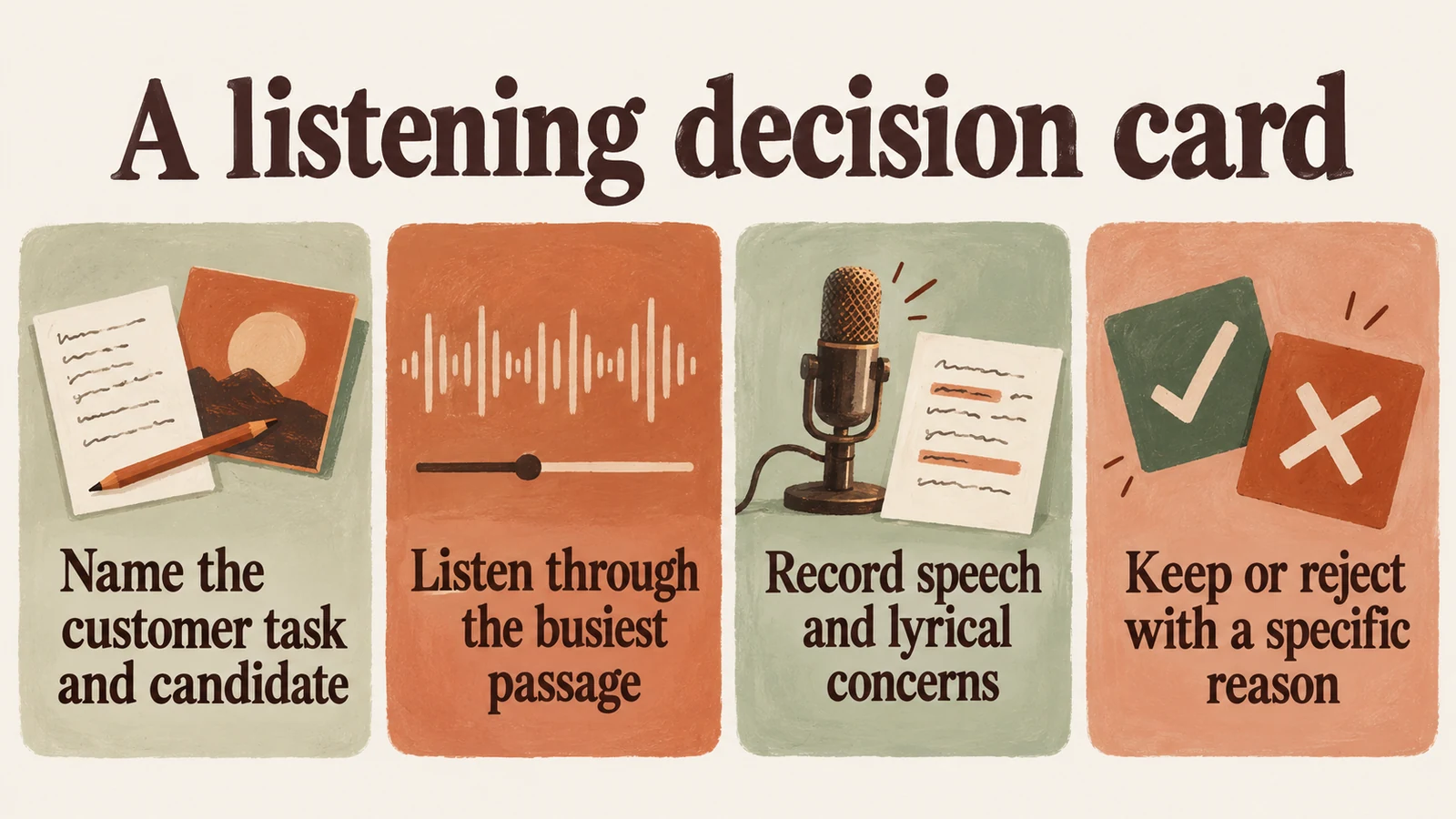
Keep a short listening decision card
Give each candidate a reason to stay or go. Note the customer activity, the busiest passage, whether speech remained clear and any lyrical-content concern. That record helps a colleague repeat the choice without needing your musical taste.
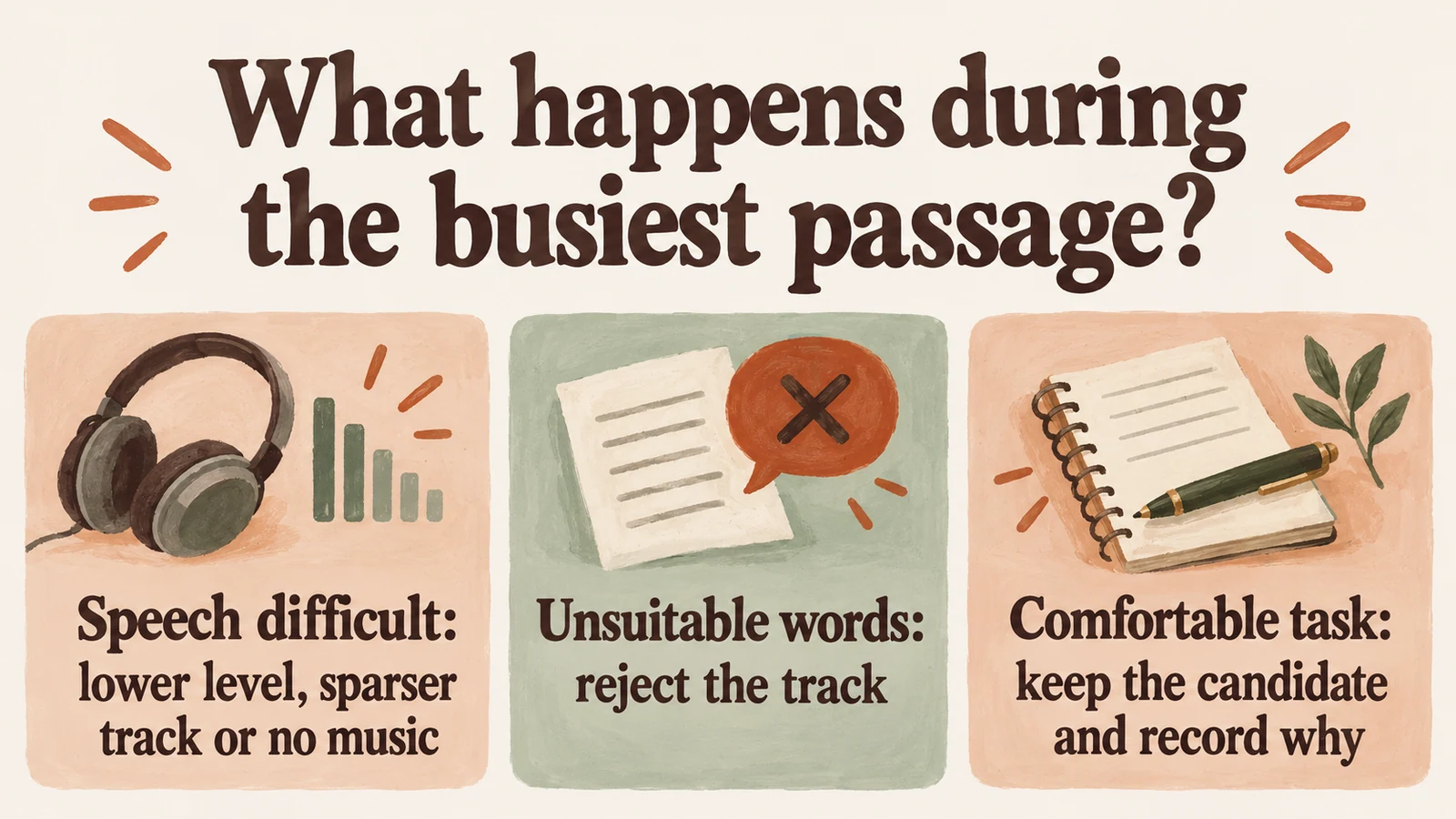
Example: compare both candidates while explaining the same product at an ordinary speaking level. If one has a much busier arrangement, record that difference. You have compared two whole tracks, not isolated the scientific effect of lyrics.
Keep loudness as a separate check with the background-music volume guide. If the advertised session promises no music, use the quiet-hours guide; an instrumental still counts as music.
Instrumental or vocal music: what are you actually comparing?
Compare understandable words, vocal prominence, the busiest arrangement and the playback level against the customer task. Instrumental and vocal labels help you find candidates; they do not tell you how the whole track behaves in the room.
For your shortlist, separate four things that are easy to bundle together:
- Words you can understand, including their subject and suitability.
- How far forward the voice sits compared with the other instruments.
- How busy the arrangement becomes, especially at the chorus or a solo.
- How loudly you are playing it in the room.
Music suppliers take different positions. Brandmusic presents its business-music catalogue, while Jukeboxy's office page includes instrumental and light vocal recommendations. Those are providers describing their choices, not proof that one approach is best for your premises.
A wordless vocal texture is different from a clearly sung story. An instrumental with sharp brass entries is different from a sparse guitar piece. Even the same song can have versions that make quite different demands on the listener's attention. Treat the label as a way to find candidates, then listen.
Examples: two choices, different answers
At a salon consultation
Imagine comparing an instrumental with quick piano runs and sudden drum fills against a slow vocal track with a soft lead voice and a steady accompaniment. Your colleague explains a colour choice while each plays.
The instrumental has no lyrics, yet its busiest passage keeps drawing your ear. In the vocal track, the words sit further back and the conversation feels easier to follow. You might keep that vocal candidate, subject to checking the full lyrics.
The conclusion is narrow. This vocal track fits this consultation better than that instrumental. You have changed several things at once, including arrangement and pace, so you have not proved that lyrics help conversation.
At a cafe counter
Now compare a gentle instrumental with a vocal track whose chorus jumps forward and repeats a clear phrase. Imagine a customer giving an order just as that chorus arrives. If you find yourself following the sung phrase instead of the order, try the instrumental or choose a less prominent vocal.
Do not try to rescue an unsuitable track simply because its genre matches the cafe. A different track may be enough. If both candidates get in the way, lower the level or try no music for that part of the room.
Make the choice about the activity
Use this as a starting comparison, not a prescription for every venue of that type.
| Customer activity | Candidate to try | Reason to reject that candidate |
|---|---|---|
| Discussing a salon treatment | Restrained vocal or sparse instrumental | Either distracts from the explanation at its busiest point |
| Browsing a gift shop | A vocal track that fits the shop's character | Its lyrics or repeated hook feel wrong for the setting |
| Ordering at a cafe counter | Instrumental with an even arrangement | A solo or sudden change still competes with the order |
Lyrics deserve their own decision. Decide what language and subject matter you are comfortable playing to customers. Listen beyond the opening verse. A soft delivery does not tell you whether the words are suitable, and not understanding the language is not a content check.
Try a short paired listen
Choose a handful of candidates from each side. Compare them through the same speaker setup at a similar perceived level. The same volume setting does not necessarily make two recordings sound equally loud.
Include a verse, chorus and any obvious change in intensity. Ask a colleague to carry out the real task with you, such as describing a return or confirming an appointment. Note the specific moment that worked or failed instead of recording only "liked it".
For example, write "voice too prominent in chorus" or "piano fill interrupts the explanation". These notes give the next person something to select against. A brief listen is a practical screening exercise, not evidence of improved concentration, sales or customer satisfaction.
If every candidate seems intrusive, use the fuller background-music volume guide before excluding all vocal music. The issue may be the level or speaker position rather than lyrics.
Compare the catalogue before committing
In Sonosfera's music browser, the music-track view has Instrumental and Vocal choices. Use them to build a shortlist of individual tracks. These choices do not filter the curated playlists into instrumental-only or vocal-only selections.
Sonosfera supplies its own catalogue. Its terms describe catalogue playback at the locations on an active plan, including background music and instructor-led classes. That scope does not cover music from other sources, and the catalogue excludes major-label repertoire. If your requirement is a list of particular chart recordings, assess that separately.
For the relevant venue offer, see Sonosfera's business types and current UK pricing once the music itself fits.
For another setting where spoken explanations matter, use the salon music plan to place that choice in the service routine.
Does one choice have to win everywhere?
No. You can prefer sparse instrumental music for spoken explanations and allow restrained vocals where customers browse. You can also decide that one room needs no shared music. The useful outcome is a selection rule tied to the activity, not a permanent ban on voices.
Choose the track that leaves room for the customer task. Keep the reason for that choice alongside the shortlist so the next selection follows the same rule.
This applies to Sonosfera's own catalogue at the locations on your plan. No PPL PRS licence needed for Sonosfera music under an active plan. Music from other sources needs its own licence. See the catalogue terms for the locations and uses covered by your plan.
Frequently asked questions
Is instrumental music always better for a business?
No. Listen to arrangement, vocal prominence and the customer task. A busy instrumental can interrupt speech more than a restrained vocal.
Can I filter Sonosfera playlists to remove vocals?
The Instrumental and Vocal choices apply to individual tracks in the music-track view. They do not turn curated playlists into instrumental-only or vocal-only selections.