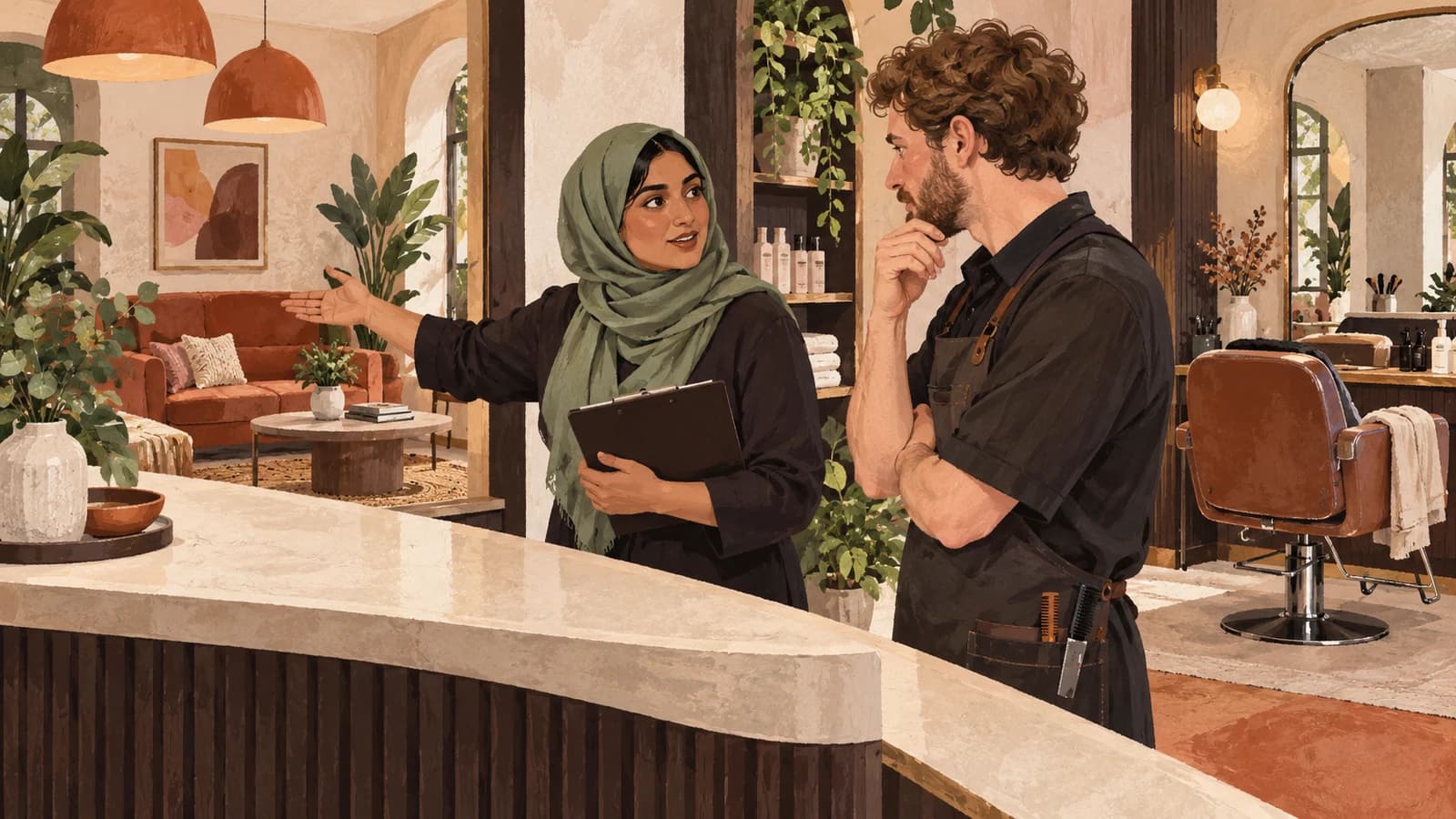
Short answer: A salon background music plan maps the customer journey—arrival, consultation, service, waiting, payment and reset—to a small number of music and volume rules. Reception protects names, bookings and advice. Service areas need consistency. Any quieter room should become a separate zone only when its listening need genuinely conflicts with the main salon.
This plan is for hair, nail and beauty salons. It makes no therapeutic, relaxation, retention or spending claim. Use it as an operating hypothesis and test it in your real rooms.
Salon music plan at a glance
| Moment | Room job | Starting direction | Protect |
|---|---|---|---|
| Opening | Make the salon feel ready | Warm, polished, restrained | Staff setup and first bookings |
| Reception / consultation | Welcome and understand the client | Clear, low-interruption | Names, services, colour and treatment discussion |
| Main service | Support a long customer visit | Consistent, varied without sharp jumps | Conversation and staff coordination |
| Busy crossover | Keep energy without audio clutter | Slightly brighter, controlled level | Reception calls and adjacent chairs |
| Final appointments / reset | Settle while remaining open | Lower intensity, steady continuity | Final service and payment |
The same track may reach several moments at once. Build around rooms and simultaneous needs rather than pretending every chair is a separate scene.
What should salon background music do?
Salon music should make the space feel intentional while leaving consultations, conversations and service instructions easy. It should remain suitable across a long appointment and predictable enough that staff are not constantly correcting it.
Competitors treat salons as a distinct business-music category. Rockbot lists salon and spa among its industries, and Soundtrack describes business scheduling and central control. Those pages establish category competition, not a customer result.
Arrival and reception: protect the first conversation
Set reception from the client's position. Names, phone calls, booking details and prices must remain clear. A speaker above the desk can make a reasonable main-floor level feel excessive at the exact point where speech matters most.
Use a warm, low-interruption direction. If the room is empty at opening, avoid over-correcting for the silence; the salon will sound different once dryers, conversation and movement begin.
Run the ten-minute volume check at opening and during a busy crossover.
Consultation: reduce competition, not personality
Consultations can happen at reception, a chair or in a separate room. The music does not have to disappear, but prominent vocals or sharp dynamics should not compete with detailed questions.
Write one rule: “during consultation, normal speech must stay easy at the client's position”. If staff repeatedly lean closer or repeat service details, lower the local level or adjust the zone.
During a consultation, use the instrumental-versus-vocal listening check to judge the explanation against the whole arrangement.
Main service: consistency across a long visit
Customers may hear several tracks during one appointment. Prioritise continuity: avoid abrupt changes in intensity, volume or content. Variety still matters, but it should feel like one salon rather than a sequence of staff preferences.
Define:
- broad vibe range;
- vocal tolerance;
- content exclusions;
- handling for an unsuitable track;
- timing of busier and quieter periods;
- who owns adjustments.
The business music brief template turns those choices into a one-page instruction.
Busy crossover: distinguish energy from loudness
When several clients arrive, phones ring and tools run, music may feel less present. Test whether the salon needs a brighter direction before raising the master level. Extra volume can make reception harder precisely when the team is busiest.
Walk these positions:
- entrance and reception;
- a chair closest to the speaker;
- a chair at the room edge;
- any wash, treatment or waiting area;
- payment point.
Record local problems. One hotspot may need speaker or zone work rather than a global change.
Treatment room or wash area: when to split a zone
Create a separate zone only if a room needs different music or volume at the same time. A closed treatment room may justify one. An open wash area that shares the main sound comfortably may not.
Before splitting:
- confirm the needs genuinely conflict;
- listen at the doorway for competing tracks;
- decide who controls each area;
- define a fallback if one zone stops;
- avoid claiming that separate music creates a health or treatment benefit.
Use the multi-zone background-music guide for the full decision map.
Final appointments and salon reset
Lower intensity gradually where the room changes, but do not make a final client feel they are being hurried. Keep customer-facing content appropriate until the appointment and payment are complete.
If staff use different music after customers leave, define that as a separate operating and rights decision. Do not let a post-close preference leak back into customer-facing service.
Salon staff handover
Give the shift lead a short policy:
- use the approved salon source and schedule;
- protect consultation, calls and payment;
- adjust only approved vibe and volume controls;
- do not connect personal accounts;
- block or log unsuitable tracks;
- take repeated timing or room problems to the weekly review.
Copy the staff music policy and replace the protected task with “consultation, booking and payment speech”.
How Sonosfera fits a salon plan
Sonosfera's current product page says Autopilot schedules morning, afternoon and evening playback for each location. Its remote can show rooms, switch vibe and set volume. Customer-facing playback is described as explicit-free, and unsuitable tracks can be banned.
That supports a repeatable salon operation without claiming a client outcome. See Sonosfera music for salons or current pricing.
Frequently asked questions
What music is best for a beauty salon?
Choose a consistent direction that fits the brand while keeping consultation and conversation clear. Test vocals, dynamics and level in the real salon rather than relying on genre alone.
Should reception and treatment rooms use different music?
Only when they need different sound at the same time. A closed treatment room may justify a separate zone; an open salon often works better with one coherent soundtrack and local volume control.
How loud should salon background music be?
Set it so names, booking details, service advice and payment conversation remain easy. Re-check during busy periods when dryers, tools and customer conversation change the room.
Can salon staff choose the music?
The owner should define the approved sound and exclusions. One shift lead can handle bounded vibe and volume changes; other staff should report recurring issues rather than use personal accounts.
Plan the whole customer journey
A salon background music plan should connect reception, consultation, service and reset while protecting speech throughout. Start small, test occupied rooms and fix repeated local problems instead of chasing individual preferences.
Try Sonosfera in your salon with the journey map and one-page handover.
Sources
- Rockbot: Music for Businesses — checked 2026-08-19.
- Soundtrack: How It Works — checked 2026-08-19.
- Ambsonic: Background Music Volume Checklist — competitor intent reference, checked 2026-08-19.