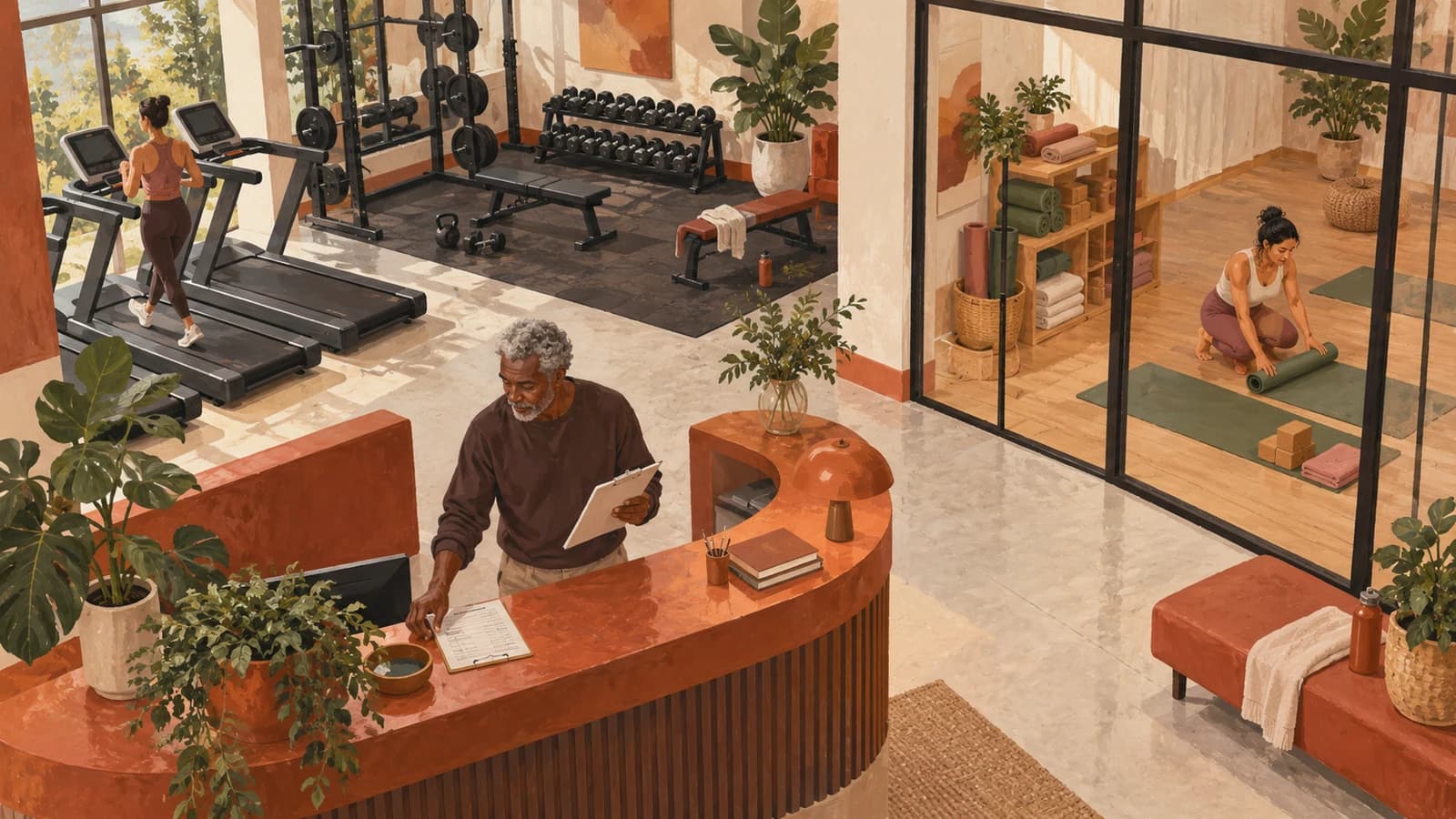
Short answer: Gym music zoning means grouping spaces that can share the same music and separating spaces with conflicting simultaneous needs. Reception protects enquiries and tours; the open floor can carry more energy; instructor-led classes need their own programming decision; stretching or recovery areas may need a lower-intensity boundary. Use the fewest zones that make those jobs work.
This guide is for gyms and fitness centres planning background music. It does not prescribe workout tempo, improve performance, replace instructor-led class programming or provide safety/acoustic advice.
Gym zone map
| Space | Main job | Starting sound direction | Key boundary |
|---|---|---|---|
| Reception | Welcome, explain, sell and check in | Present, clean, speech-first | Do not inherit the full floor level |
| Open gym floor | Support general movement | Consistent energy, controlled content | Staff instruction remains audible |
| Class studio | Follow the class and instructor | Separate programming decision | Prevent spill into floor/reception |
| Stretch / recovery | Support lower-intensity activity | Calmer, fewer sharp changes | Avoid collision with the main floor |
| Changing / corridor | Provide continuity where appropriate | Related, lower-interruption | Privacy, announcements and local rules |
Not every gym needs all five. A small studio may need one background zone and a separate class source. A large club may need several.
What is gym music zoning?
Gym music zoning is a room-by-room control plan for music and volume. It exists because a fitness site can contain incompatible activities at the same time. The plan should reflect those activities before it reflects the number of speakers.
Current competitors target the same room problem. Ambsonic's gym and fitness page discusses reception, floor, class and recovery contexts, while Rockbot lists fitness as a business-music industry. These pages are competitor evidence, not proof of a performance or member outcome.
For a US location, pair the room map with the US group-fitness music checklist; UK licensing guidance does not transfer to that venue.
Reception: treat speech as the primary function
Reception handles names, memberships, tours, calls and questions. It should feel connected to the gym without forcing staff to compete with the floor.
Test from the visitor's side of the desk. If routine information is repeated, lower the local level, change speaker direction or separate reception from the floor. Do not solve a reception problem by flattening the whole gym unless the whole gym is wrong.
Write the zone job as: “welcoming and energetic enough to belong to the gym, with ordinary enquiries easy”. That gives the shift lead a usable standard.
Open floor: consistent energy without audio chaos
The open floor may contain cardio, resistance training and general movement. One coherent background direction is usually simpler than treating every equipment area as a separate experience.
Check:
- entrances to the floor;
- positions directly beneath speakers;
- staff instruction points;
- quieter equipment areas;
- boundaries with studios and recovery spaces.
Avoid universal BPM or volume prescriptions. The right operating level depends on the room, equipment noise, speaker layout and protected instruction. Use the background-music volume checklist in the occupied gym.
Class studio: separate background music from class programming
An instructor-led class is not simply another background-music zone. The instructor may need timing, cues or programme-specific content. Treat that as a separate use case with its own source, rights, safety and operating decisions.
For zoning, focus on spill:
- stand outside the closed and open studio door;
- run the floor and class sources together;
- check whether rhythms collide at reception or nearby equipment;
- lower or redirect the boundary before increasing either room;
- define which source wins during transitions.
Sonosfera is discussed here for business background playback, not as a claim of class-synchronised programming.
For a UK site, the gym licence and class-use checklist keeps background areas, timetabled classes and outside sources separate.
Stretch and recovery: decide whether a split is real
A recovery area may need lower intensity, but it does not automatically need a separate feed. If it is an open corner of the floor, speaker direction and local level may be enough. If it is a closed room used simultaneously, a separate zone may make sense.
Use the general multi-zone background-music decision table: split when activity, speech, timing or ownership conflicts; keep one zone when the sound can remain coherent.
Changing areas and corridors: continuity with restraint
Background music in circulation spaces can connect the venue, but these areas also have different privacy, announcement and local requirements. Use a related direction at a restrained level where appropriate, and check operational, legal and building obligations separately.
This guide does not decide whether music should be used in every changing area. Document the actual site decision and keep announcements or safety communication clear.
Zone ownership and fallback
Assign one shift lead to the background zones. Record:
- approved vibe per zone;
- normal volume reference;
- who controls class playback;
- what happens during a class transition;
- what source is used if a zone fails;
- how unsuitable content is logged or blocked;
- when a repeated spill problem is escalated.
The staff music policy template provides a copyable responsibility table.
Gym dayparts within zones
Zoning handles simultaneous differences; dayparting handles changes over time. A gym may have a quieter opening, a busier pre-work period, daytime steadiness and an evening peak. Keep those schedules broad and let each zone preserve its own job.
Use the business music dayparting guide to mark real traffic changes. Do not create a new block for every class unless the background zones genuinely need to change.
How Sonosfera fits a gym zone plan
Sonosfera's current product copy says one phone can show every room, switch vibe and set volume. Playback supports Chromecast, Nest and Cast-group speakers. It also describes customer-facing playback as explicit-free and allows an unsuitable track to be banned.
Those features support bounded background-zone control. They do not replace speaker design, instructor programming or a professional assessment. See Sonosfera music for gyms and current pricing.
Frequently asked questions
Does a gym need separate music zones?
Only when spaces need different music or volume at the same time. Reception beside a high-energy floor is a common conflict; a small open studio may work with one background zone.
Should gym reception use the same music as the floor?
It can use a related sound, but reception must protect enquiries, tours and calls. If the floor level makes ordinary speech difficult, lower or separate reception.
Is class music the same as gym background music?
No. Instructor-led classes may need timing, cues and programme-specific choices. Treat class playback as a separate operational and rights decision from general background music.
Can Sonosfera control several gym rooms?
Sonosfera's current product page says one phone can show every room, switch vibe and set volume, with Chromecast, Nest and Cast-group playback support.
Use the fewest zones that work
A good gym music zoning plan protects reception, keeps the floor coherent, treats classes separately and prevents sound collision at boundaries. Begin with the room jobs, not the equipment list.
Try Sonosfera with your gym zone map and validate every boundary during the hours you actually operate.
Sources
- Ambsonic: Background Music for Gyms and Fitness Studios — competitor intent reference, checked 2026-08-19.
- Rockbot: Music for Businesses — checked 2026-08-19.
- Soundtrack: How It Works — checked 2026-08-19.