Direct answer: Music licensing for group fitness in a US gym should match the actual class use, music source and location. A background-music plan does not automatically cover every class, and a personal streaming account does not become a business licence because an instructor uses it. Get the class permission in writing before playing the music.
By Sonosfera Team
Start with music for gyms for the venue plan. Then list floor music, instructor-led classes, reception audio, visiting instructors and any online sessions separately. The checklist below helps a manager collect the right answers without treating every supplier or music use as identical.
Put each music use on its own row
| Use | Information to collect | Question for the provider or rights holder |
|---|---|---|
| Gym-floor background | Source, areas and plan location | Does this agreement cover the music in these areas? |
| Instructor-led class | Source, class format and venue | Does it expressly permit this class use? |
| Visiting instructor | Who supplies the account and recordings | Which permission covers the music they bring? |
| DJ or featured event | Supplier, repertoire and event details | Which event permissions are required? |
| Recorded or streamed class | Destination, replay and included music | What additional recording, video or transmission rights are needed? |
An instructor saying “I have a music account” leaves the key question unanswered. Ask which account, which recordings, which location and which use the agreement covers. Keep the answer with the class timetable.
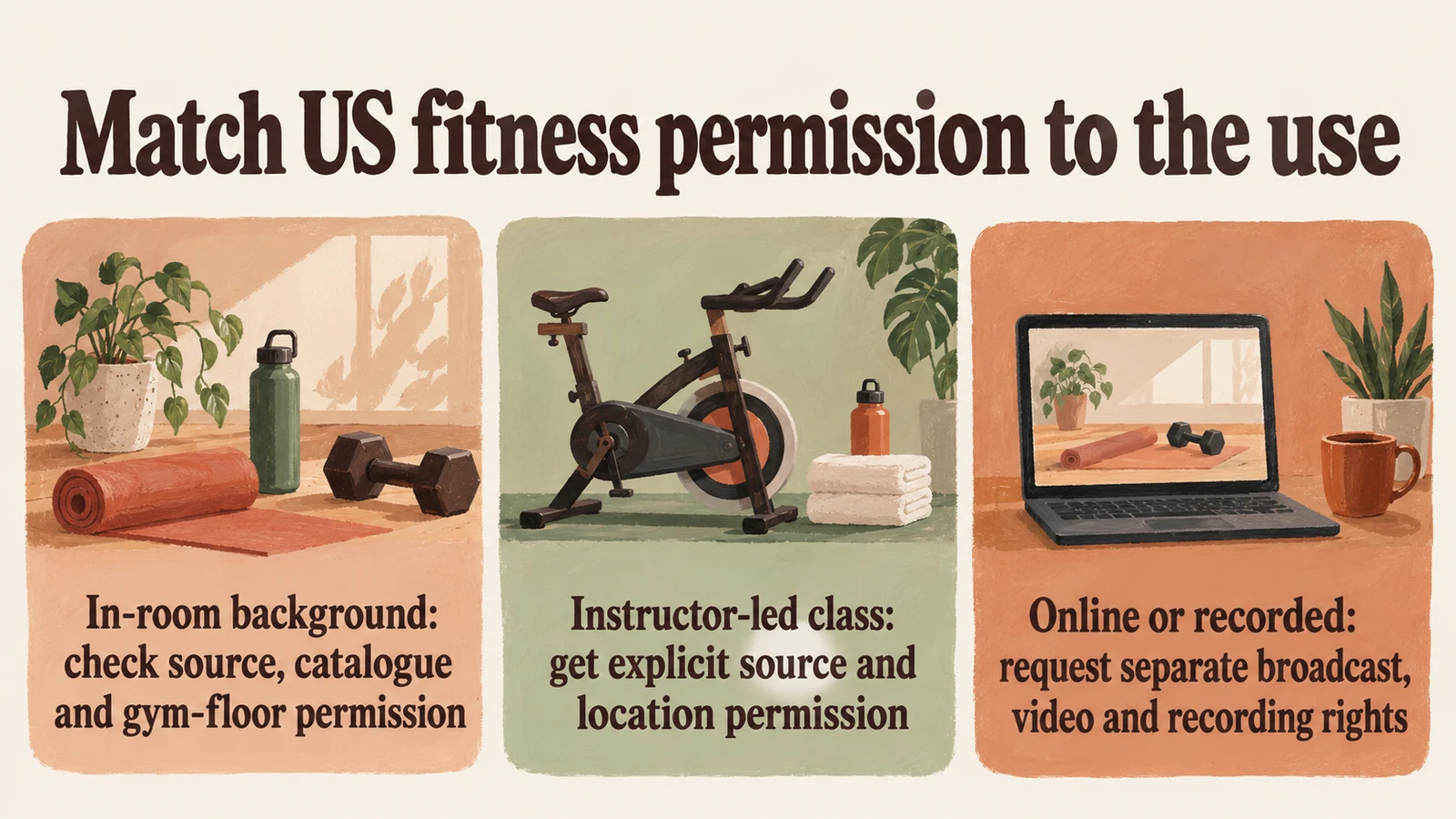
Consumer playback and business permission are different
Spotify states that its service is for personal, non-commercial use. A paid consumer plan therefore does not solve public playback in the gym. Changing the phone or connecting it to a commercial speaker does not change those terms.
For US public-performance questions, identify the musical works and applicable rights holders. The US Copyright Office explains the public-performance rights in section 106. A gym's precise arrangement still needs assessment; do not copy a UK licensing answer into a US class plan.
ASCAP, BMI, SESAC and GMR are separate routes associated with different repertoires. A supplier's agreement may provide relevant permissions or directly license its own catalogue. Ask what is actually covered rather than assuming every gym needs the same bundle. Use the ASCAP business-music guide for that narrower question.
Song rights and recording rights are different questions
The US Copyright Office's section 106 separates the public-performance right in musical works from the sound-recording right involving digital audio transmissions. That distinction matters when reading advice from another country. An ordinary in-room US gym scenario and an online class do not present exactly the same rights questions. A licence discussion about songwriters does not settle every recording, video or transmission use.
Keep the use description concrete: members hear music in the weights area; an instructor plays recordings during a class; or a session is recorded and made available afterwards. Do not answer the third question with paperwork obtained for the first. Where a recording or livestream is planned, ask for the additional permissions in writing before making the video, rather than after distributing it.
Check each repertoire instead of assuming one PRO covers everything
ASCAP, BMI, SESAC and Global Music Rights are separate licensing organisations. Their official business routes are starting points for the relevant repertoire, not interchangeable certificates. BMI's licensing directory explicitly lists a Fitness Club route and describes its licence as permission to use BMI music. Use the actual fitness business route when requesting terms.
| Official route | Question to resolve for this gym |
|---|---|
| ASCAP | Which agreement and repertoire apply to these rooms and classes? |
| BMI | Which Fitness Club terms apply to the proposed music use? |
| SESAC | What permission is needed for the SESAC repertoire actually used? |
| Global Music Rights | Is the proposed repertoire and use covered directly or through the named supplier? |
A mainstream-music provider may arrange permissions under its own agreement, while a catalogue owner may license its own music directly. Ask the provider to identify the covered repertoire, country, locations and uses. Neither “business music” on a homepage nor the existence of a PRO payment establishes coverage for every track and activity. This guide does not invent a flat US gym tariff: obtain current official rates or a written offer tied to your business details.
Compare a gym-floor plan with the class arrangement
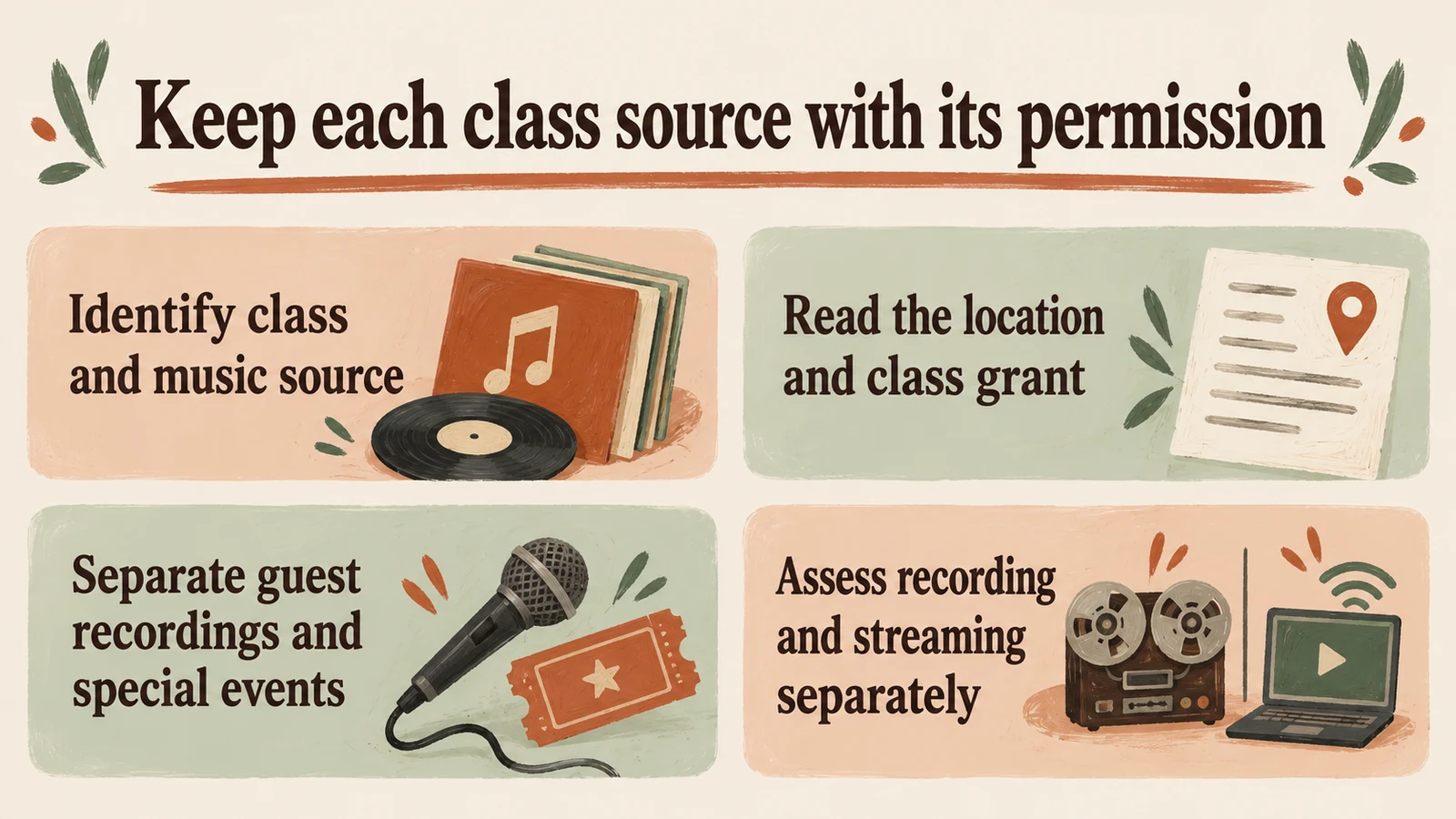
Compare only the scope you can check. Give each shortlisted provider the same source register and timetable. Ask separately about floor playback, instructor-led classes, guest instructors, DJ events, recording and streaming. A response for background listening belongs in that row; leave the class row unresolved until it has its own answer.
Example: a studio could have Sonosfera music at reception and in an instructor-led class, but hire a guest who brings named commercial recordings for a special session. Sonosfera's terms address its own catalogue at active-plan locations. They do not transfer to the guest's library. The manager should keep the guest source distinct and resolve its permissions before that session.
Frequently asked questions
Can a personal Spotify subscription cover a paid fitness class?
No. Spotify's official public-use guidance limits its consumer service to personal, non-commercial use. A PRO arrangement does not rewrite that account contract. Use a suitable source and confirm permission for the actual class.
Do all business-music plans exclude instructed classes?
No. Class permissions vary by plan. Read the named plan's current terms: Sonosfera's terms expressly include instructor-led fitness, yoga and Pilates classes for its own catalogue at active-plan locations. Another supplier's background plan needs its own class-scope check.
Does one music certificate cover visiting instructors' phones?
Only if the permission actually covers the recordings and use they bring. A certificate for one catalogue does not automatically extend to another streaming account, downloaded files or a guest's mix. Record the device's source and agreement, not merely the instructor's name.
Sonosfera includes its own catalogue in instructor-led classes
For a US gym using Sonosfera music at the locations on an active plan, the current terms expressly include background music and instructor-led classes such as fitness, yoga and Pilates. The catalogue is not represented by a collecting society. Music from other sources needs its own licence; Sonosfera does not pay those charges or supply permission for a visiting instructor's separate library.
This is a Sonosfera guide. Its offer fits a gym willing to choose from the Sonosfera catalogue. The US monthly plan is $14.99 per month per zone; review current US pricing. Scope checked 16 October 2026. It is not a promise of particular chart tracks or permission to record and distribute a class video.
Listen with an instructor before choosing. The licensed scope and the class's musical fit are separate tests. If a format relies on specific recordings, confirm their availability rather than assuming a background catalogue can replace them.
For a separate event, use the US event source checklist rather than extending the ordinary class arrangement.
Send this class-permission request
Copy this into a supplier enquiry and fill in your actual details:
We operate at [venue address]. We want to use [service and plan] for [class format], led by [our staff or visiting instructor]. Please confirm whether the agreement permits those recordings in this in-person class, which locations it covers, what outside music is excluded, and whether any additional rights or charges apply. We will assess online, recorded and special-event use separately.
Ask for an answer tied to the plan, not a general homepage slogan. Keep any exclusions beside the approval so a later instructor does not inherit an incomplete account of the permission.
What to do when a source changes
Review the row when a substitute instructor brings a phone, a class adds a video, or a fundraiser adds a DJ. Pause the changed source while its scope is checked. The ordinary approved source can remain a separate decision.
If a rights organisation contacts the business, keep the correspondence, identify the music and use concerned, and obtain advice appropriate to the question. Do not ignore it or assume a certificate for another source answers the enquiry. This guide is practical preparation, not legal advice about a dispute or penalties.
For a UK studio, use the separate UK gym licence guide. For a US catalogue decision, browse Sonosfera, check the terms and then compare US plans against the source register.