Direct answer: A gym music licence in the UK depends on the music source and how it is used. Separate gym-floor background music from fitness or dance classes before requesting a quote. PPL PRS has guidance for both. For Sonosfera's own catalogue, an active plan licenses background music and instructor-led classes at the locations on the plan.
By Sonosfera Team
Do not budget from floor area alone when your timetable includes classes. Equally, do not count a reception stream, a visiting instructor's phone and an online class as one source. The current tariff examples below keep class charges, floor music, minimums and effective dates separate.
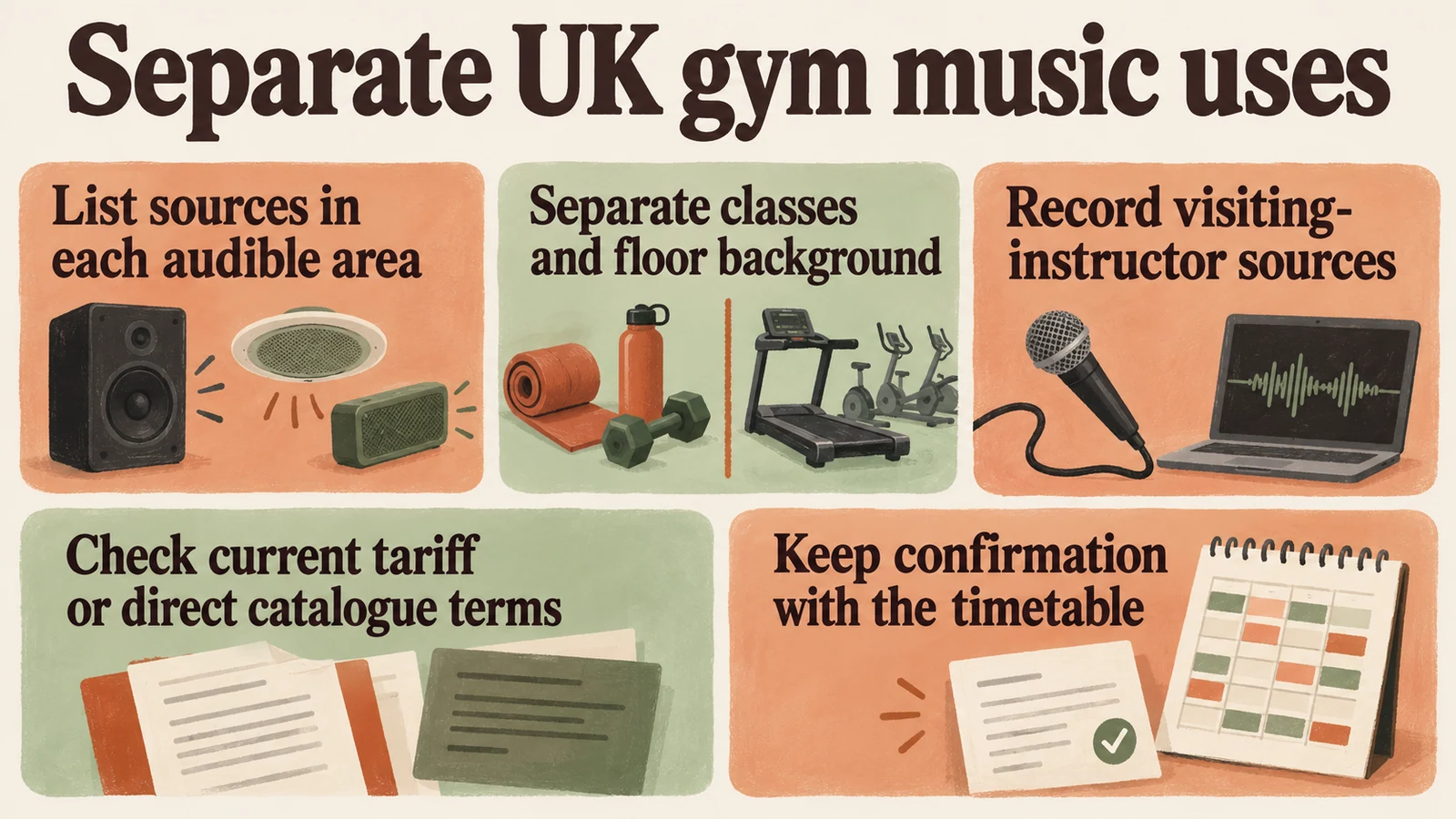
Start with the source and the activity
PPL PRS's fitness and dance guidance distinguishes gyms and studios from independent instructors. Its gym and studio page describes background areas and class uses. Use the current guidance for the actual business rather than choosing a tariff by the word “gym” alone.
| Music use | Facts to record | Evidence to request |
|---|---|---|
| Weights and cardio floor | Audible areas, source and operating hours | Applicable background-use scope |
| Fitness or dance classes | Class types, timetable, location and operator | Applicable class scope and calculation basis |
| Reception or cafe | Operator, source and audible area | Whether included or assessed separately |
| Visiting instructor | Who supplies music and account | Their source and permission for the use |
| Online class or replay | Where the music is transmitted or recorded | Separate permission for that destination |
Why class costs need their own calculation
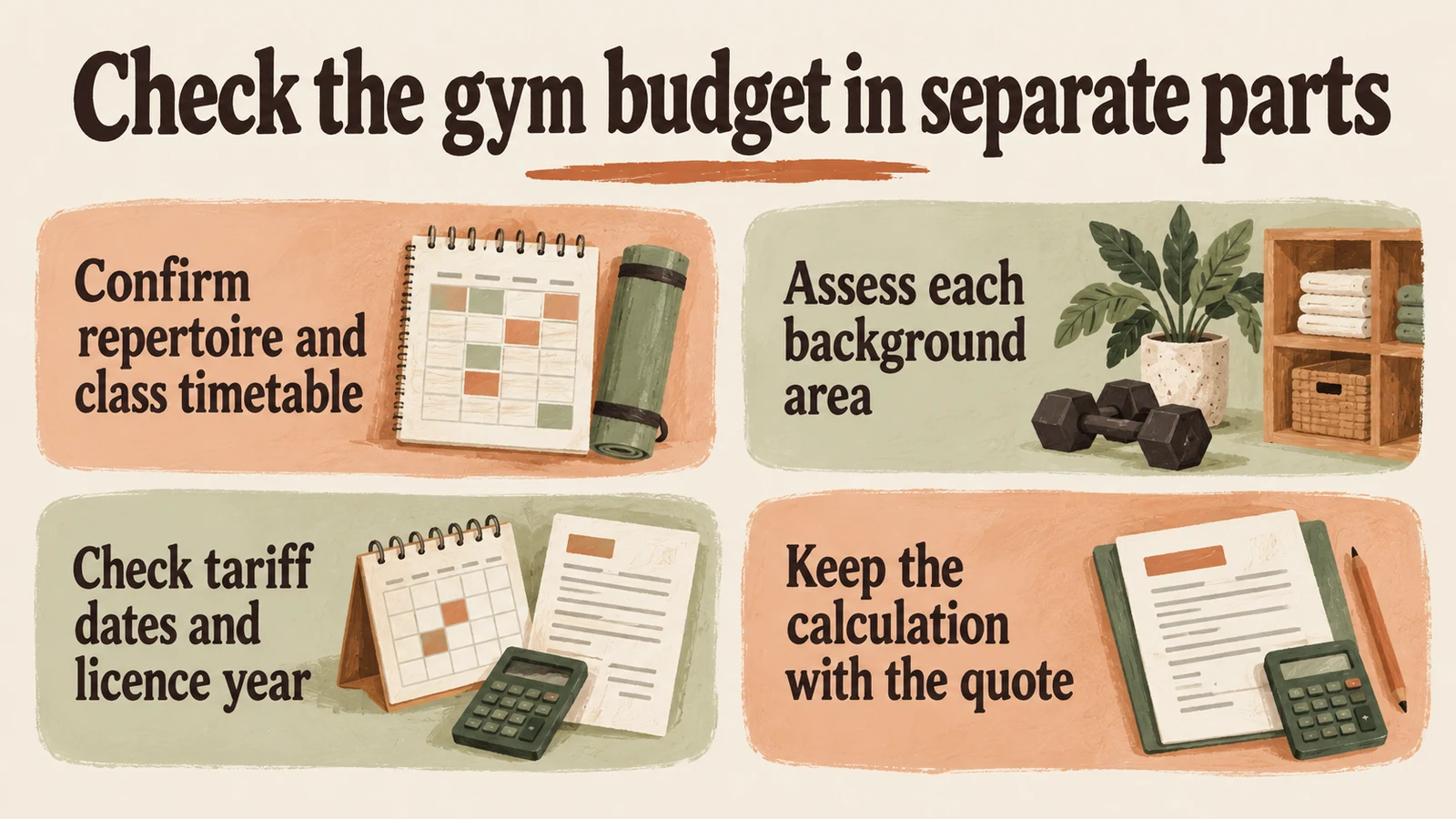
The PPL PRS tariff directory is the place to obtain the current documents. Read the effective dates, definitions, minimums and any conditions before applying a rate. An old blog's annual example is not a substitute for the current tariff or a quote for your venue.
Keep the arithmetic visible even when the amounts come from a quote. Example: for a studio running ten classes a week for fifty weeks, the planned total is 500 classes, calculated as ten multiplied by fifty in this timetable worksheet. That is a timetable calculation, not a tariff quotation. Apply only the current class rate and conditions confirmed for the use; assess background areas separately where required.
Write down the assumptions: weeks operating, cancelled classes, classes run by outside instructors, and any music between sessions. If a minimum, surcharge or other component applies, show it separately. This makes a supplier's answer easier to check without reproducing a rate table or implying that every venue owes the same total.
Current PPL and PRS class rates
As of 16 October 2026, the published class rates are £2.30 for PPL and £2.38 for PRS: £4.68 combined per fitness class, excluding VAT. These are third-party licence charges, separate from a music-service subscription. The PPL Exercise To Music tariff applies from 1 May 2026 to 30 April 2027; the PRS Fitness & Dance tariff applies from 1 February 2026 to 31 January 2027. Check the relevant licence year and actual repertoire with PPL PRS before treating an illustration as your bill.
PPL's class fee has no attendance or floor-area bands. PRS separates background use from fitness classes, so a studio with music between classes can have an annual Core Music component as well as its per-class component. This is the distinction a floor-area-only estimate misses. It also explains why a small room with a busy timetable can have a larger class bill than a bigger room with fewer sessions.
The PPL definition includes yoga and Pilates as well as other group exercise formats. It also covers video-led instruction; replacing the instructor with a screen does not, by itself, change the tariff classification. Its responsibility provisions distinguish classes within or controlled by a fitness centre from an independent instructor's class outside one, such as a hired hall. Use those definitions with the actual operator and booking arrangement rather than assuming every room owner handles every class.
PRS Core Music: area bands and a conditional minimum
As of 16 October 2026, the PRS Fitness & Dance document has five audible-area bands, from £299.02 a year excluding VAT for 0–99 m² to £1,357.08 for 950 m² and above. A 100–249 m² example uses £559.69. Find the applicable band in the official document; these endpoints and worked examples do not reproduce its full ladder.
Core Music uses the total audible area, including the staff-only areas described in the tariff. Measure where the music can be heard, rather than substituting the lease's total floor area without checking it. Record a separately operated café or crèche as a separate operator: the tariff excludes those third-party-operated areas from its scope and says they are licensed separately.
The same PRS document lists £1.52 per dance lesson and a £73.71 annual minimum where the premises has only Bolt-on Music usage. That minimum is conditional, not an extra annual charge to add automatically to every Core Music calculation. A tuition-based dance lesson and a fitness class also have separate definitions. Describe the session accurately instead of choosing whichever label produces the lower number.
Worked budget for a class-based studio
Example: a studio has a 90 m² audible area, music between sessions, ten fitness classes each week, and fifty operating weeks (assumptions). Its 500-class timetable is also shown in the calculation worksheet.
Using the class rates and Core Music band above, checked 16 October 2026, the calculation is:
| Component | Calculation | Annual amount excluding VAT |
|---|---|---|
| PPL fitness classes | 500 × £2.30 | £1,150.00 |
| PRS fitness classes | 500 × £2.38 | £1,190.00 |
| PRS Core Music, 90 m² | Applicable example band | £299.02 |
| Subtotal for these components | £1,150.00 + £1,190.00 + £299.02 | £2,639.02 |
The combined class amount is £2,340.00, before the background component (worked calculation). The arithmetic follows the PPL class tariff and PRS tariff. It is not a complete quote: separate workout areas, other sources or uses, applicable minimums, tax and licensing conditions still need assessment. A supplier's monthly subscription is another line, not already included in this subtotal.
Change the timetable before reusing the example. Count actual planned sessions, closures and seasonal operation; keep the assumptions alongside the calculation. Ask PPL PRS how changes and reporting are handled under your agreement. A copied annual total is less useful than a calculation that another manager can trace back to the relevant classes and rooms.
Gym-floor fees and effective dates
As of 16 October 2026, PPLPP049 for gymnasium workouts states £193.42 a year excluding VAT, effective 1 September 2026 to 31 August 2027. PPLPP054 for leisure centres and health/fitness clubs also states £193.42 for that period, but covers a different background use and directs workout use to PPLPP049. Equal rates do not make the permissions interchangeable; ask which uses and tariffs apply to your premises.
For comparison with an earlier bill, the 2025 workout tariff and 2025 leisure-centre tariff each stated £187.60, effective 1 September 2025 to 31 August 2026. That is a historical rate, not today's fee. The earlier worked combination of £187.60 plus the PRS 100–249 m² amount of £559.69 was £747.29 (historical calculation). Substituting the current £193.42 workout amount gives £753.11, before classes, VAT or other applicable components (current calculation). These examples assume the stated use; they do not decide whether a premises needs additional background tariffs.
Keeping the earlier period visible helps explain why an old invoice and a current quote differ. It does not justify renewing at the old amount. Save the effective dates with the source document and check the next renewal date, particularly where different components change in different months.
Minimum fees, surcharges and the published hall example
As of 16 October 2026, the PPL minimum-fee document for October 2026 states £81.83 per year excluding VAT, effective 1 October 2026 to 30 September 2027. The preceding document stated £79.45, effective 1 October 2025 to 30 September 2026. PPL says the minimum is applied once per licence account in a licence year unless a tariff specifies otherwise. Do not add it to every class or every room as though it were a separate per-use charge.
Both the PPL class tariff and PRS Fitness & Dance tariff describe a 50% surcharge for the unlicensed-before-licensing situations they specify. Read the respective conditions rather than treating the percentage as an automatic penalty for any administrative mistake. If there is already a dispute, keep the correspondence and obtain advice about those facts.
The PPL PRS cost page, checked 16 October 2026, lists £345.00 in its Annual Cost (+VAT) column for an instructor holding three classes a week for fifty weeks in a village hall or similar premises. Its page labels its examples as updated in February 2026. The arithmetic is 150 classes × £2.30 = £345.00 (worked calculation). That matches the PPL per-class amount; it is not evidence that a fitness centre's combined PRS, PPL and background-use bill is only £345.00. Use it as a defined published example, not a universal package price.
Questions owners ask about the class bill
Is a quiet yoga class charged by the size of the studio?
For PPL repertoire under PPLPP222, yoga is included in the fitness-class definition and the charge is per class. PRS's separate Core Music background component uses audible area. Neither a quiet session nor a small room removes the need to identify the music source and the applicable permissions.
Does a hired hall arrange everything for the instructor?
Not automatically. The PPL class tariff puts classes outside a fitness centre, such as an instructor's hired-hall session, on the instructor's licensing route. Ask the hall what its own agreement covers and keep the class confirmation separate. The hall-hirer checklist helps record that distinction.
Do these class tariffs apply to Sonosfera music?
Sonosfera's own catalogue has its separate active-plan grant, described below. Do not apply a tariff for PPL or PRS repertoire to Sonosfera music merely because it is used in a gym. Conversely, a Sonosfera plan does not license an instructor's outside recordings. Record the source first, then assess the permission for that source.
Sonosfera's class scope is explicit
The Sonosfera terms license its own catalogue at the locations on an active plan for background music and instructor-led classes, including fitness, yoga and Pilates. No PPL PRS licence is needed for Sonosfera music under that plan. This does not cover radio, TV, other streaming services, live performers, a DJ's recordings or your own files. Those sources need their own licence.
For a studio choosing this catalogue, the UK monthly plan is £14.99 per month per zone. Compare current UK plans after checking the music suits the class. Scope checked 16 October 2026. Sonosfera publishes this guide, and it is an option for its own catalogue rather than a route to every named chart recording.
Keep the class timetable beside the source register
An agreement can be clear while the day-to-day handover is not. A substitute instructor may use a different account, or a class may add a streamed video. Record that change before the new source plays. Do not treat the provider selected for reception as permission for everything audible in the building.
Use the multi-zone guide to distinguish independent background streams. If an instructor hires a community venue, the village-hall responsibility checklist addresses the hall and hirer question. A US gym needs the separate US group-fitness guide.
A request that produces a useful quote
Send the licensing body or supplier the same description you use internally:
- Business name, address and operator.
- Each audible area and the music source used there.
- Fitness and dance class formats and annual timetable assumptions.
- Who supplies music for visiting instructors.
- Any cafe, separate tenant, event, DJ or live music.
- Any recording, transmission or replay beyond in-person playback.
Ask them to identify the applicable documents, effective dates and what is excluded. Keep the answer and the next review date with the register. A change of source or activity is a reason to check again, even if the room's floor area stays the same.
Before choosing a plan
For a background and class catalogue you can assess yourself, visit music for gyms, listen to Sonosfera and review its terms. If your format needs specific recordings or an outside source, resolve those permissions separately. The useful budget is the one that matches your actual timetable and sources.