Direct answer: Overhead music for pubs should leave orders and table conversation easy to hear, with a separate plan for lunch, busy bar service and closing. Use a business-suitable source, name the person who controls each zone, and document the UK licence position for every music source. A single playlist and volume setting rarely describe the whole pub.
By Sonosfera Team
Start with the dining room and bar, then add the terrace, toilets and any function room to your walk-through. A television, jukebox or visiting DJ belongs on a separate source row. The purpose of this guide is a repeatable service plan, not a promise that particular tracks increase takings.
Make a room and service-period plan
Write down what customers and staff need to hear in each area before choosing genres. A dining table needs conversation; the bar needs clear orders; a function room may need a completely different source. Where two systems are audible together, resolve that overlap before adding music.
| Service moment | Starting choice to test | Check from the room | Person who can change it |
|---|---|---|---|
| Lunch and food service | Steady, lower-distraction selection | Can a server explain the menu without raising their voice? | Lunch supervisor |
| Busy evening | More energy only if it suits the crowd | Can staff hear orders at the busiest counter? | Duty manager |
| Televised sport | Decide which source has priority | Are commentary and music competing? | Named TV operator |
| Terrace | Assess the area separately | What is audible at its boundary and indoors? | Duty manager |
| Closing | Agreed finish or silence | Has the next shift inherited an active source? | Closing supervisor |
Walk the route during the service you are planning. An empty-room check does not describe the same room when it is full.
For a restaurant-led pub, use the hospitality music route. If the rooms need different streams, the multi-zone background music guide helps you separate the playback plan.
Example: lunch service to the last orders
A pub has a dining room, a front bar and a terrace. The duty manager leaves this plan for a Friday shift:
| Time and room | Music decision | Check and handover |
|---|---|---|
| Noon–half past two, dining room | Use a restrained acoustic or instrumental selection | Lunch supervisor checks that menu explanations are easy to hear at the furthest table |
| Half past two–five, dining room and bar | Keep the quieter selection while the team resets tables | Stop an unwanted restart; check the counter before raising the level |
| Five–nine in the evening, front bar | Try a livelier selection while keeping the dining room quieter if independent playback is available | Duty manager listens during the loudest chorus and checks orders with bar staff |
| Nine–close, bar and terrace | Follow the agreed evening finish; stop terrace playback at its permitted end time | Closing supervisor stops music, removes guest devices and leaves the next day's opening selection |
If televised sport starts at half past seven in the evening, name the TV operator and stop competing music in that audible area. A DJ booking gets its own source and permissions check. Adjust these example times to the pub's opening hours and premises conditions.
Pick music staff can run through a shift
Give staff a short, named selection for each service period and a clear fallback. “Choose something nice” leaves too much to whoever reaches the device first. Record why a selection belongs in the room and which tracks or transitions should prompt a change.
Listen beyond the opening song. A quiet introduction can lead into a much more prominent chorus. Check both the busiest passage and the change to the next track. If the real problem is a repeated opening sequence, adding songs to the end will not necessarily help. Use the playlist-length worksheet to distinguish runtime, distinct tracks and restarts.
Keep the observation simple: service period, room, track or source, what became difficult to hear, and what changed. Avoid treating staff taste as customer evidence. Ask for specific examples rather than collecting votes for a genre.
Check the UK music source and licence separately
GOV.UK says businesses usually need TheMusicLicence for public recorded or live music. The actual source and use matter. Spotify says its consumer service is for personal, non-commercial use, so paying for a personal account does not make it a pub music service.
For Sonosfera's own catalogue, the terms license playback at the locations on an active plan, including background music and instructor-led classes. No PPL PRS licence is needed for Sonosfera music under that plan. Radio, TV, DJs, live performers and other music sources need their own licensing checks. The Sonosfera subscription does not cover them or pay their collecting-society charges.
Keep the source name, plan locations, invoice and scope wording with the pub's records. When someone proposes a new source for a match, party or terrace event, update that row before using it.
How to assess the effect without promising more sales
Start with service quality: repeated orders, complaints, staff volume changes and unwanted repeats. Those observations help diagnose an operating problem. They do not establish that music caused a change in revenue. Promotions, weather, staffing and the event calendar also change a pub's trading day.
Read what pub music research can and cannot show about revenue before attaching a sales target to a playlist. Keep one clear operational question for your own trial, such as whether staff can hear orders during the busiest passage.
Before the next shift
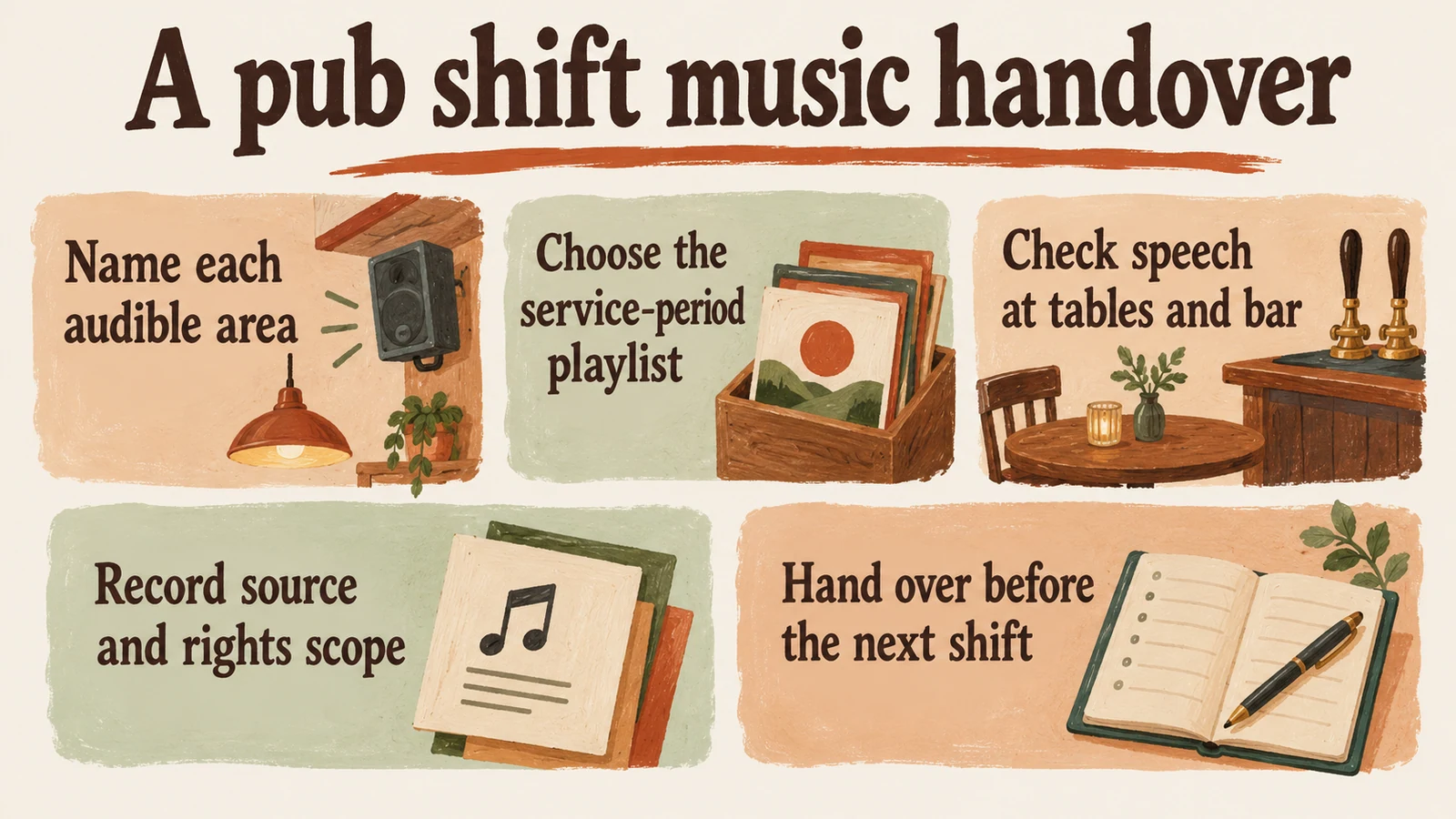
- Name the current source and approved areas.
- Leave the next service-period selection and fallback in writing.
- State who may change volume or stop playback.
- Remove visiting devices and personal accounts from the handover.
- Check TV, terrace and function-room audio separately.
- Keep licensing evidence beside the source record.
For a catalogue-led background setup, browse Sonosfera and compare current UK pricing. Choose another route if particular chart recordings, a live act or a DJ set are essential. Get the room and source plan right before choosing the subscription.