UK pub, bar and nightclub music licence: PPL PRS, costs and atmosphere
By Sonosfera Team
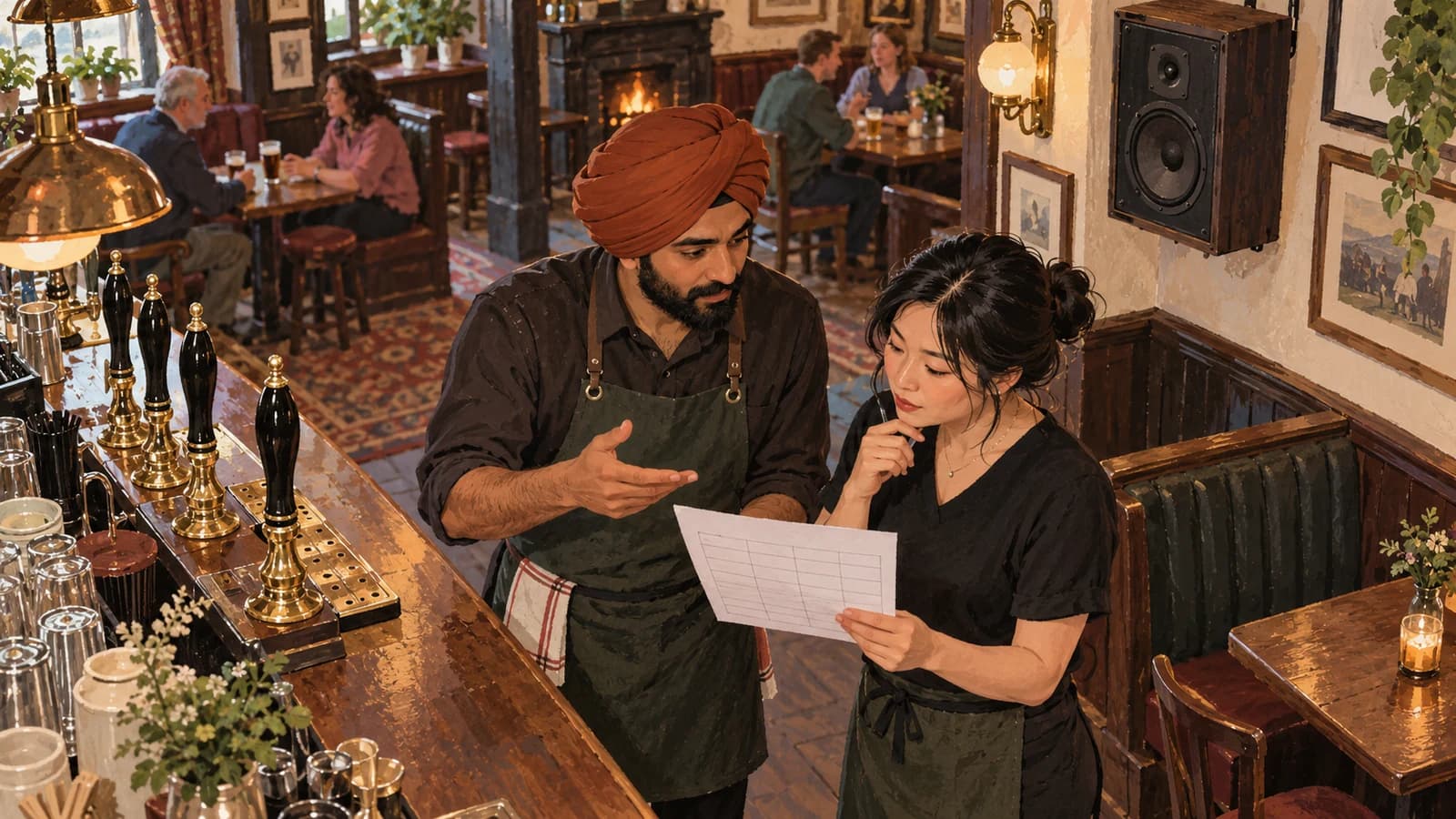
Walk into a good pub on a quiet Tuesday afternoon and the music is barely there — just enough to soften the room and stop two strangers feeling like they're sharing a library. Walk into the same pub at 9pm on a Friday and the energy is doing real work: it lifts the mood, keeps people at the bar, and tells the room what kind of night this is. Getting that right is part craft, part law, and most landlords end up learning both the hard way.
This guide is for UK pub, bar, gastropub and late-night venue owners and managers. The licensing half of it does something most pub articles don't: it takes the single blended figure everyone quotes and pulls it back apart into the two tariffs it is actually made of, because the moment you do that, the number stops being a mystery and starts being something you can check against your own floor plan. It is not a nightclub, live-event or premises-licence guide; DJ nights, dancing, live gigs and televised sport can all change the checks you need.
One licence, two societies, two completely different sums
If you play recorded music where customers or staff can hear it — speakers, a TV, a radio, a streaming app — that is a public performance, and public performance of music is licensed in the UK. GOV.UK lists pubs, bars and nightclubs among the venue types that usually need a licence.
What gets lost in almost every write-up is that there is no such thing as a PPL PRS tariff. There are two societies with two separate tariffs, and TheMusicLicence is the joint venture that invoices you for both at once:
- PRS for Music licenses the composition — the song as written, on behalf of composers and publishers. Pubs fall under Tariff 'P'.
- PPL licenses the recording — the specific recorded version coming out of your speakers, on behalf of performers and labels. Background music in pubs falls under PPLPP210.
They do not price the same way. PPL bands on the total audible area of your premises. PRS bands on your bar area — and then on what you're playing the music through. Two tariffs, two definitions of "how big is your pub", two renewal dates. That is the entire reason a single quoted figure never survives contact with a specific venue.
"Royalty-free" does not mean "no licence." It means the provider says it has already cleared the music so nothing is owed to PPL or PRS on top — which only holds if the catalogue genuinely sits outside both societies' repertoire. Ask for that in writing and keep it on file.
If the venue also runs a late-night DJ programme, the nightclub source handover register keeps background playback and featured suppliers distinct.
The PPL half: PPLPP210, priced on audible area
PPL's background-music tariff for pubs, bars, restaurants, cafés and hotels runs 1 January 2026 to 31 December 2026. All figures below are ex-VAT — the tariff says so on its face, and VAT is added at the prevailing rate.
"Audible area" means every square metre where the recordings can be heard. The tariff is explicit that this includes corridors, toilets, lifts and reception areas, and that in a pub it includes any restaurant or food section. It is not the same thing as your bar area, and it is not the same thing as your licensed capacity.
PPL prices this one in 13 audible-area bands running from £204.19 ex-VAT at the bottom (1–400 m², which covers most pubs outright) to £510.43 at the top (951–1000 m²). We are not reprinting the ladder — PPL's tariff PDF is stamped "For Information Only Publication Strictly Prohibited", and it is one click away if you want to find your own band.
You do not really need the table anyway, because the tariff tells you how to build it. Every band is £25.52 above the one below it, per 50 m², and it keeps stepping at that rate above 1000 m². So:
Work out your own band. Start at £204.19 for anything up to 400 m². Above that, count every started 50 m² — round up, because a band you have entered at all is a band you pay — and add £25.52 for each.
A 620 m² pub is 220 m² above the base band. That is five started 50s (220 ÷ 50 = 4.4, rounded up), so £204.19 + (5 × £25.52) = £331.79 ex-VAT — the 601–650 m² band. A 780 m² pub is 380 m² over, eight started 50s: £204.19 + (8 × £25.52) = £408.35, the 751–800 m² band. Check either against the PDF and the printed band agrees, which is the point of publishing the formula rather than the table.
Three rules attached to it that are worth knowing:
- Concessionary discount. If your audible area is 50 m² or less and you only use traditional BBC/Ofcom-licensed radio or TV broadcasts, you may qualify for 50% of the 400 m² band fee. Play a CD, or charge for admission, and you lose it. PPL publishes the rule but not the resulting figure, so we are not printing one either.
- 50% surcharge if you were playing before you got the licence. It is a deterrent, and it is stated in the tariff.
- PPL's minimum fee — £79.45 a year ex-VAT to 30 September 2026, rising to £81.83 from 1 October 2026 — applies once per licence account, unless a tariff says otherwise.
The PRS half: Tariff 'P', priced on bar area and equipment
PRS for Music's pub tariff has been effective since 1 October 2025 and is uplifted every 1 October. Ex-VAT again.
Two things make it behave differently from the PPL side. First, "bar area" is a narrower measurement: it is the drinking area wall to wall, excluding the counters and the serving areas behind them, and excluding function rooms and restaurants — those are charged under other PRS tariffs entirely. Second, there are only two area bands, and the real variable is your equipment.
Standard royalty, bar area up to 120 m²:
| What you play music through | Annual royalty ex-VAT |
|---|---|
| Stand-alone radio | £155.76 |
| Stand-alone television and/or system television | £124.60 |
| Record, CD or tape player, and/or digital music service | £311.59 |
| Music centre, radio-cassette or CD radio-cassette player | £387.19 |
| Video player | £186.94 |
For a bar area of 121 m² or more, each of those is a flat 50% increase — the tariff states the relationship itself, so £155.76 becomes £233.64 and £311.59 becomes £467.39. The minimum annual royalty is £124.60.
There is also a "higher royalty" column running 50% above these. It is not a different service level; it applies to a first licence year entered after you had already started playing.
The line that matters most to anyone reading this: a streaming or digital music service sits on the same row as a CD player, at £311.59, not on the radio row at £155.76. That single choice is a £155.83 a year difference on the PRS side alone, and almost no published pub-cost article mentions it.
Why six publishers quote six different numbers for the same pub
Here is what happens when you ask the internet what a small pub pays. Every figure below is quoted as its publisher states it, checked on 1 August 2026.
| Publisher | Figure as published | VAT basis | Venue shape attached | Why it differs |
|---|---|---|---|---|
| PPL PRS (the licensor) | £359.95 per year | + VAT | 400 sqm or less, via radio | Not a tariff — a marketing worked example, which is why we treat it as a check rather than a source. It agrees exactly with the two tariff rows (£204.19 + £155.76), and PPL PRS publish the same £359.95 on both their sector page and their general cost page (both checked 2026-08-02). Its own jukebox example is £596.31. The radio assumption travels silently into every page that copies it. |
| Auracle Sound | £420–£438 | + VAT | under 400 m² | No source, no date. The range brackets older editions of the same official radio example rather than a genuine minimum and maximum. |
| MelodyRights | around £420 | plus VAT | 400 m² or less, "radio or streamed music" | Same stale vintage, plus a worse fault: radio and streaming are two different Tariff 'P' rows (£155.76 vs £311.59) collapsed into one figure. |
| Background Sounds | around £504 | inc VAT | 400 sqm or less, via radio | £420 × 1.2. An old ex-VAT figure grossed up, so it reads ~40% above the current radio total while resting on the identical assumption. The only inc-VAT entry here. |
| Orange Jelly | £500–£800 | ex VAT | "small pub, background music only" — no m² threshold | Cites nothing and calls itself indicative. The floor sits almost exactly at the streaming-source total, on a row labelled background music only. Both tariffs band on floor area; "small" cannot be checked against either. |
| SmartPubTools | £300–£450 | not stated | 60–80 customer capacity | Tiers by capacity, a metric neither tariff uses. Read ex-VAT, the floor is below what any compliant small pub can pay. |
| Sonosfera's own cost calculator | £359.95 | + VAT | audible area no greater than 400 m², background music only | Same number as the licensor's example, and we inherit the radio assumption with it — our figure understates the PRS line for a venue playing through a streaming service, including ours. Named here because a reconciliation that omits its own author is not a reconciliation. |
Same pub, £300 to £800, before anyone has agreed on VAT. The spread is not mostly disagreement about the tariff. It is four separate failures stacked: quoting one society's half as if it were the whole, copying an old tariff year, switching VAT basis mid-comparison, and attaching the figure to a venue measurement the tariffs do not use.
So what does a small pub actually pay in 2026? If your audible area is 400 m² or less, your bar area is 120 m² or less, you are on the standard rather than the higher royalty, and you play through a stand-alone radio: £359.95 ex-VAT across both societies. Same pub through a streaming service or CD player: £515.78 ex-VAT. Those are sums of published tariff rows, not estimates — but they are floors for the simplest possible venue, and every one of those four conditions has to hold. Add a function room, a DJ, a jukebox, live music, or a bigger footprint and you are into rows this page does not cover. Get the binding figure from PPL PRS.
Atmosphere: matching the music to the day
Licensing keeps you legal. Atmosphere is what actually earns the music its place. The single most useful idea here is the daypart — the recognition that a pub isn't one room but several different rooms wearing the same walls at different hours.
- Daytime and early afternoon. Low tempo, low volume, mostly familiar and unobtrusive. The job is to remove silence, not to fill it. People come in to read, work, or talk; music that demands attention works against you.
- Late afternoon into early evening. A gentle lift. Slightly brighter, slightly louder as the room fills. This is the transition where the pub stops being a daytime space and starts becoming an evening one.
- Peak evening. Higher energy and a bolder volume — but watch the line where "lively" becomes "I can't hear my friend." Crowd noise rises, so the music can rise with it, yet conversation should still be possible without shouting.
- Closing wind-down. Pulling the tempo and volume back down is a quiet, effective way to signal that the night is ending, without flicking the lights on abruptly.
A comfortable background level is roughly conversational — you should be able to talk across a table without raising your voice during quieter trading, and the music should sit under the crowd rather than over it at peak. Tempo matters as much as genre: a slow soul track and a fast indie track can both be "the right genre" and create completely different rooms.
How the main UK background-music services compare
If you'd rather not curate playlists yourself, several services package business background music for pubs with their own rights route. The table uses each provider's own publicly stated pricing and positioning. Confirm the current details on each provider's site before you commit, and treat any claim that a catalogue sits outside PPL and PRS repertoire as something to verify in writing, not assume.
| Service | Published price (as of July 2026) | Positioning | What to check |
|---|---|---|---|
| Background Sounds | £15 + VAT/month per site (£150 + VAT/year) | Royalty-free, positioned as outside PPL/PRS; certificate on request | No mainstream chart music; confirm the catalogue position suits your venue |
| RadioSparx UK | From £13.50/month | Royalty-free background music for UK businesses | Treat the no-PPL/PRS claim as provider positioning until confirmed |
| Tribe of Noise for Business | £20/month | Legal alternative to consumer streaming | Check cancellation terms and catalogue fit |
| Auracle Sound | £32 + VAT/month | Licensed background music for business | Confirm exactly how PPL/PRS is handled for your use |
A few services are quote-led and don't publish prices. Startle and Imagesound both sell curated commercial music to hospitality venues but work on a demo or quote basis — and both make clear that UK businesses generally still need PPL/PRS on top. Soundtrack's UK guidance says the same: public performance rights are not included, and you should hold TheMusicLicence where it applies. That is the honest contrast: chart music your regulars recognise almost always means you still need TheMusicLicence, and on the PRS side it means the £311.59 row, not the £155.76 one.
Where Sonosfera fits
Sonosfera is a background-music service built for hospitality, with mood-matched playlists you can shift across the trading day rather than a single static feed. You don't need a PPL PRS licence to play Sonosfera. Our catalogue is fully rights-controlled and sits outside PPL and PRS repertoire, so you can play it across the trading day without adding a licence for it. Every track you play through Sonosfera is included. If you also play other sources — chart radio, a jukebox, third-party playlists, live music or a DJ — those need their own licence, and for most pubs that means TheMusicLicence. Rights documentation is available on request. Review country-aware pricing and weigh it against the alternatives above.
For neighbouring pub and bar decisions, also read Music License Pub UK: Do You Need One?, Pub Music Licence Cost UK, and Best Background Music for Pubs. If a letter has already arrived, PPL PRS contacted my business covers what to do about that specifically.
FAQ
Do I need a TV licence as well as a music licence for my pub?
They're separate things. TheMusicLicence covers playing music. If you show live TV broadcasts you also need a TV Licence, and note that a television is its own row on PRS Tariff 'P' at £124.60 ex-VAT — cheaper than the radio row, which surprises most people.
Why is my quote higher than the £359.95 figure everyone repeats?
Most likely one of three reasons, and they are checkable. Your audible area is above 400 m², which moves the PPL band. Your bar area is above 120 m², which adds 50% to the PRS side. Or you play through something other than a stand-alone radio, which moves you from the £155.76 PRS row to £311.59 or higher. The published example assumes the cheapest combination of all three.
Which measurement do I actually give them?
Both, and they are different. PPL wants the total audible area including corridors, toilets and any food section. PRS wants the bar area only, wall to wall, excluding the counters and serving areas, and excluding function rooms and restaurants. Measuring once and quoting the same number to both is a common way to end up on the wrong band.
How loud should background music be in a pub?
Loud enough to remove dead silence, quiet enough that people can talk comfortably without raising their voices during normal trading. As the room fills in the evening the music can rise with the crowd noise — but if customers are leaning in to be heard over the speakers, it's too loud for a pub.
What happens if I play music without a licence?
It is a civil copyright matter, not a fine: the societies sue for damages and an injunction. The tariffs also carry a stated 50% surcharge for having played before licensing. Music licence fines UK sets out what the published judgments actually say.
Sources
How much checking is behind each figure. The band ladder above is ours: we hold PPL's base fee and its stated £25.52 step and compute the rest, then check the computed band against the printed one — so every band except the first is independently reproduced. The £204.19 base fee itself rests on the tariff document alone, because there is nothing in the tariff to recompute a base from. The same is true of the PRS Fitness & Dance rates quoted in our gym guide. The PRS Tariff 'P' equipment rows below are independently reproduced, against the tariff's own stated rule that the larger-bar column is exactly 50% higher. Where a figure rests on one document we say so rather than implying two.
- PPLPP210 — Background Music Tariff, Public Houses/Bars/Restaurants and Cafes/Hotels, effective 01-JAN-26 to 31-DEC-26 — Phonographic Performance Limited. Verified 2026-08-01.
- PRS for Music Tariff 'P' (2025.10) — Public Houses, effective 1 October 2025 — PRS for Music. Verified 2026-08-01.
- PPL minimum fee, October 2025 and October 2026 — PPL PRS Ltd.
- Pubs & Bars music licence cost examples — PPL PRS Ltd.
- Get a licence to play live or recorded music — GOV.UK.
- Publisher figures in the reconciliation table, all accessed 2026-08-01: Auracle Sound, MelodyRights, Background Sounds, Orange Jelly, SmartPubTools.
Next step
Measure twice — audible area for PPL, bar area for PRS — then check which equipment row you're really on before you accept any quote. Confirm the binding figure with PPL PRS. If a daypart-friendly, own-catalogue option fits your pub, compare country-aware pricing against the alternatives above.