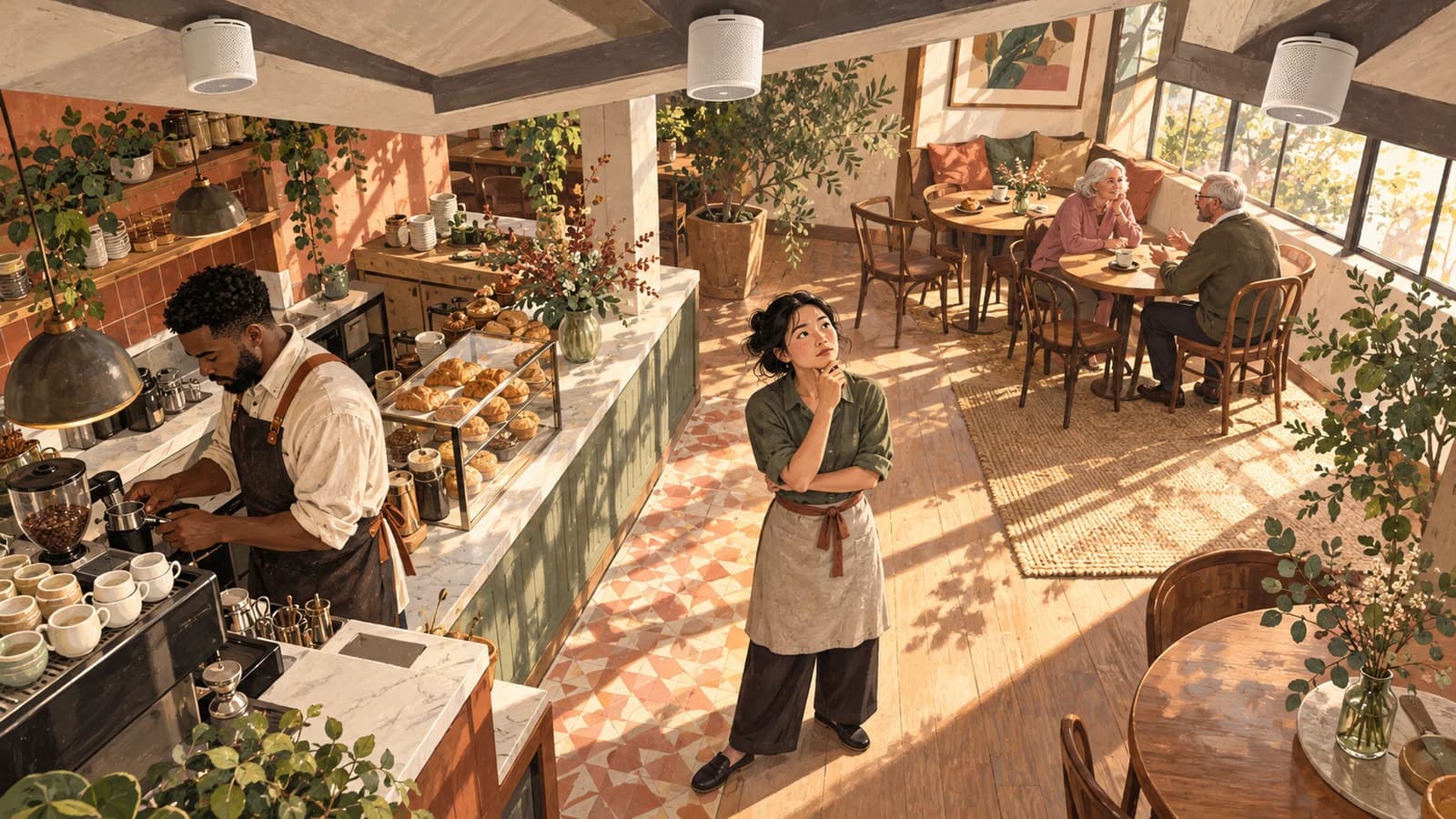
Short answer: A useful café music schedule usually has three to five blocks: warm opening, steady work-friendly morning, brighter lunch trade, an optional afternoon reset and a calmer close. Each block should change the feel without making orders or conversation harder. Start with broad directions, test them during real service and keep the first version stable long enough to learn.
This plan is for independent cafés, bakery cafés and coffee shops that want repeatable background music rather than shift-by-shift improvisation. It is an editorial starting template, not evidence that one genre, tempo or schedule will improve sales, focus or customer stay.
If the counter and tables hear very different levels, check ceiling speaker placement. If conversation is difficult even with music off, use the restaurant acoustics checks to separate room noise from the schedule.
Café daypart schedule template
| Daypart | Room job | Starting music direction | Check in the room |
|---|---|---|---|
| Setup and opening | Make a quiet room feel ready | Warm, restrained, steady | Staff preparation and first orders remain easy |
| Work-friendly morning | Support conversation and individual work | Consistent, light vocals or instrumental-leaning | Laptops and calls do not fight the music |
| Lunch / busy trade | Add motion without adding stress | Brighter rhythm, controlled dynamics | Counter speech and table conversation stay clear |
| Afternoon reset | Prevent an energy cliff | Warm and even, slightly softer if trade drops | The room still feels open |
| Final hour / close | Settle without sounding shut | Lower intensity, familiar continuity | Remaining guests are not rushed by the change |
Merge rows that do not reflect a real service change. A three-block schedule that staff trust is better than a precise-looking plan nobody uses.
At the ordering counter, the instrumental-or-vocal comparison helps you test whether a chorus or solo competes with speech.
What should a café music schedule do?
A café schedule should support the changing job of the room while protecting ordering, conversation and customer comfort. It should not ask baristas to become DJs during a rush. The transition should feel like the same café moving through the day, not a different brand arriving every two hours.
Current category pages use this daypart framing. Ambsonic's café background-music page and daypart guide are direct current competitors. They confirm the search intent and format, not a result for Sonosfera or your café.
Opening: warm, clear and unhurried
At opening, the room is often acoustically exposed. Use a steady direction that makes the space feel ready without dominating the first order. Avoid large track-to-track jumps while staff are setting up and customers are entering a nearly empty room.
Test three places:
- the door, where the first level change is felt;
- the counter, where orders and names must be clear;
- the closest seat to a speaker, where a modest master level can still feel excessive.
Write the opening instruction as behaviour: “warm and present, with normal counter conversation protected”. That is easier to test than “acoustic chill”.
Work-friendly morning: consistency over excitement
If customers read, work or take quiet calls, reduce musical interruption. That does not require silence. It means consistent dynamics, restrained vocals where appropriate and fewer abrupt transitions.
Observe the room rather than assuming every café is a workspace. A high-turnover commuter site may move directly from opening into busy service. A neighbourhood café may have a long, quieter period. Use the general business dayparting method to mark your actual transitions.
Lunch and busy trade: add movement, protect orders
Lunch may benefit from a brighter musical direction, but energy and volume are separate controls. First change the feel; raise the level only if a room walk shows it is needed.
If the café also runs a dinner service, adapt the restaurant daypart schedule for that shift.
During live trade, check:
- whether staff repeat orders, sizes or names;
- whether the queue beneath a speaker is uncomfortable;
- whether tables can still hold ordinary conversation;
- whether percussion or bass becomes dominant near walls;
- whether one corner needs a different speaker or zone solution.
Use the ten-minute background-music volume check at the busiest realistic point. Never set lunch volume from an empty café.
Afternoon reset: avoid the sudden drop
When lunch ends, the room can lose both customer noise and musical momentum. Do not simply cut to the quietest option. Use a transition that lowers intensity while keeping the café recognisably open.
If afternoon use differs sharply—students, meetings, families or takeaway traffic—write a separate job for it. If it resembles the morning, reuse the same direction. A daypart exists to solve a repeated difference, not to make the schedule look sophisticated.
Final hour: settle without pushing customers out
The closing block should support the real service policy. Lower intensity and reduce surprising changes, but do not use music as an unspoken instruction to leave. Staff cleaning routines, lighting and stated hours should carry that message.
Keep customer-facing content appropriate until doors close. If staff want different music for the post-close reset, define that as a separate staff-only rule and check the source and rights position independently.
Counter and seating: one zone or two?
Small cafés often work best as one zone. Consider a split only when the counter and seating need conflicting sound at the same time or the speaker layout creates an unsolved hotspot.
If the seating extends outside, add the UK terrace music licence checklist to that room map.
Before adding a zone:
- adjust the local speaker level or direction;
- test the boundary during real trade;
- decide whether two simultaneous music directions are genuinely needed;
- assign who controls each area.
The multi-zone background-music guide gives a room-mapping template.
Café staff handover
Give the shift lead a short rule:
- use the approved café source and schedule;
- protect ordering and normal conversation;
- switch only to an approved vibe when trade is genuinely different from plan;
- adjust volume from the customer position, not behind the machine;
- block or log an unsuitable track instead of changing the source;
- record repeated timing problems for the weekly review.
The staff music policy template can be copied into the opening checklist.
How Sonosfera fits the plan
Sonosfera's current product copy says Autopilot schedules mornings, afternoons and evenings for each location. A phone can show rooms, switch vibe and set volume. Customer-facing playback is described as explicit-free, and an unsuitable track can be banned.
That supports the operating plan above without claiming a customer or revenue outcome. Learn more about Sonosfera for cafés or compare the current plans.
Frequently asked questions
What music should a café play in the morning?
Start warm, restrained and consistent. Protect first orders and conversation, then test whether vocals or sharp dynamics interrupt the way customers actually use the room.
Should café music change at lunch?
Change it only if the room's activity changes. A brighter direction can support busy trade, but check ordering and table conversation before changing volume.
How many dayparts does a coffee shop need?
Most first plans need three to five blocks. Start with opening, main trade and wind-down, then add a distinct peak or afternoon reset only when the room has a repeatable customer or service change.
Can baristas change the café playlist?
Define one shift owner and approved controls. Staff should not replace the business source with personal accounts; recurring content or timing issues belong in the review log.
Build version one, then listen
A café music schedule is useful when it survives a real shift. Start with broad dayparts, protect the counter, walk the seating area and review repeated exceptions after a week.
Try Sonosfera in your café with this flexible daypart template, and judge it against actual opening, lunch and close conditions.
Sources
- Ambsonic: Background Music for Cafés — competitor intent reference, checked 2026-08-19.
- Ambsonic: How to Schedule Background Music Throughout the Day — checked 2026-08-19.
- Soundtrack: How It Works — checked 2026-08-19.