By Sonosfera Team
If you run a cafe with terrace seating, the music question is usually simpler than the internet makes it sound: in the UK, playing popular recorded music in a space your customers can hear it almost always needs a licence, and an outdoor terrace is no different from the room inside. The mistake people make is assuming "outdoor" or "just a few tables on the pavement" is a loophole. It isn't.
This guide is written for independent UK cafe, coffee-shop, and bistro owners who play music on a terrace, patio, courtyard, or pavement seating area and want to know exactly what they need — without the legal fog. It covers the standard recorded-background-music situation. It does not cover live bands, DJ sets, ticketed events, or large hospitality groups, which can carry extra obligations worth checking separately.
The short answer
If you play commercial recorded music (Spotify, radio, CDs, a playlist of chart tracks) anywhere your customers or staff can hear it — indoors or on the terrace — you almost certainly need TheMusicLicence. For the cafe-specific music route, compare this with music for cafes before choosing a source.
TheMusicLicence is a single licence, administered jointly by PPL PRS, that covers two separate rights at once:
- PRS for Music — royalties for the people who wrote the song (composers, lyricists, publishers).
- PPL — royalties for the people who recorded it (record labels and performers).
Before this joint licence existed you had to deal with PPL and PRS separately. Now it's one application and one annual payment for the vast majority of venues.
Does an outdoor terrace really count?
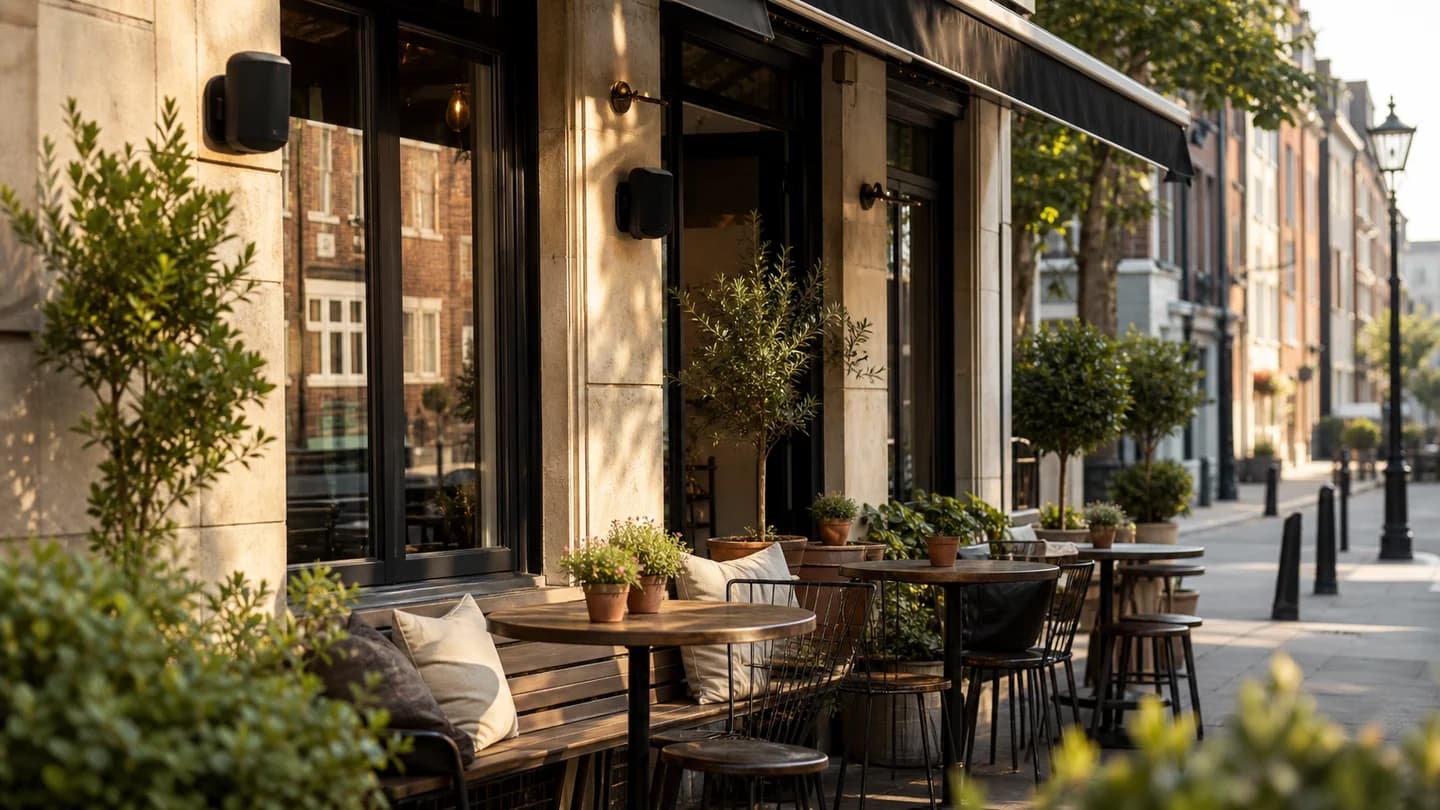
Yes. The legal trigger is "playing music in public," not "playing music indoors." A terrace, patio, beer garden, courtyard, or set of pavement tables is a public space the moment paying customers sit there and can hear the music. Speakers mounted on an outside wall, a portable Bluetooth speaker on the bar that carries to the tables, or sound bleeding out through an open door all count.
A few practical points that trip cafe owners up:
- "It's only background music" doesn't exempt you. Background use is exactly what TheMusicLicence is designed for.
- "It's only seasonal" doesn't exempt you. If you play music out there for part of the year, you still need cover for that use.
- The size of the audience affects what you pay, not whether you pay. A two-table pavement spot and a 60-seat terrace are both licensable; the tariff scales with things like floor area and audience.
What you'll pay (and why you should check, not guess)
The cost of TheMusicLicence depends on your venue — factors like audience size, the area where music is played, and how it's used. Outdoor seating can be part of that calculation. Rates are reviewed periodically, so any figure you read in an old blog post can be out of date.
Rather than budget off a number you found online, get the current rate straight from the source: pplprs.co.uk lets you check what applies to your specific setup. That's the only figure that actually governs your bill.
The alternative route: use the right cleared catalogue
Here's the part most "you must pay" articles leave out. TheMusicLicence is only required because you're playing commercial repertoire — the same recordings sold to consumers, written and recorded by artists those rights bodies represent.
If you instead play music that is royalty-free, directly licensed, or supplied with business playback rights, that catalogue may sit outside the PPL/PRS route for that music. The important part is proof: the provider should explain the rights route and give you documentation you can keep. Several UK background-music providers are built around this kind of positioning:
- Background Sounds positions its service as royalty-free and non-PRS/PPL, with a certificate available on request.
- Startle is upfront that UK businesses playing chart music usually need PPL/PRS, and sells curated commercial-music services for venues that want that route handled.
- Imagesound offers a mix of original-artist music, royalty-free music, and licensing help.
The trade-off is straightforward:
| Route | What you get | What you pay | Best for |
|---|---|---|---|
| Chart/commercial music + TheMusicLicence | The exact songs people recognise | TheMusicLicence (check current rate) + your music source | Venues where playing recognisable hits matters to the brand |
| Royalty-free / directly licensed service | A curated catalogue cleared for business use | The service subscription; check provider proof for the catalogue scope | Cafes that want a clean, predictable, hassle-free bill |
Neither is "more legal" than the other — they're two valid ways to cover the same risk. Pick the one that fits how much you care about playing specific famous tracks versus keeping paperwork and cost simple.
Where Sonosfera fits
Sonosfera is a background-music service made for venues like cafes, salons, and small hospitality. The claim is catalogue-specific: Sonosfera covers eligible Sonosfera catalogue playback, not Spotify, radio, DJs, live music, uploaded files, or third-party playlists. If your priority is a predictable background soundtrack for a cafe terrace rather than streaming the latest chart hits, start with music for cafes and keep the licence proof with your records. If recognisable chart music is central to your atmosphere, the commercial-repertoire-plus-TheMusicLicence path is the honest answer, and that's fine too.
You can see country-aware pricing for the UK here.
FAQ
Do I need a music licence for a cafe terrace if I already have one for inside? TheMusicLicence covers your premises and how you use music there, and outdoor areas are part of that picture. When you apply or renew, declare the terrace and its audience so the licence reflects your full setup. If in doubt, confirm with PPL PRS that your existing licence already includes the outdoor area.
Is royalty-free music actually legal to play in a business? Yes, if the catalogue is genuinely cleared for business playback and the provider can document that rights route. Keep the provider's licence certificate or rights documentation on file as proof.
What counts as "playing music in public" for a small pavement cafe? If customers (or staff) outside the immediate household can hear music you're playing as part of the business, it's a public performance. A few pavement tables with a speaker pointed at them qualifies, even if the audience is small.
Does a radio playing on the terrace need a licence too? Generally yes. Playing the radio aloud in a business — indoors or out — is still a public performance of the music it broadcasts, so it falls under the same licensing rules as a playlist.
Sources
- TheMusicLicence (PPL PRS) — PPL PRS Ltd (the official UK joint licensing body for PPL and PRS for Music)
- TheMusicLicence cost guide — PPL PRS Ltd
- Licence to play live or recorded music — GOV.UK
- Background Sounds — Background Sounds (royalty-free UK background music provider)
- Startle — Startle (UK commercial background music provider)
- Imagesound — Imagesound (UK background music and licensing provider)
- Best business music services in the UK — Sonosfera
- Music for cafes — Sonosfera
- UK background music comparison — Sonosfera
Next step
If a predictable, licence-light route appeals, compare the options on /compare/uk, review music for cafes, and check UK pricing. If recognisable chart music is non-negotiable, check your exact rate for TheMusicLicence at pplprs.co.uk before you commit.