Short answer: A university should keep a shared music-use ledger that names the space owner, event owner and source owner. Campus background music, students' union events, society performances, public screenings and theatrical productions are not one use just because they share an address.
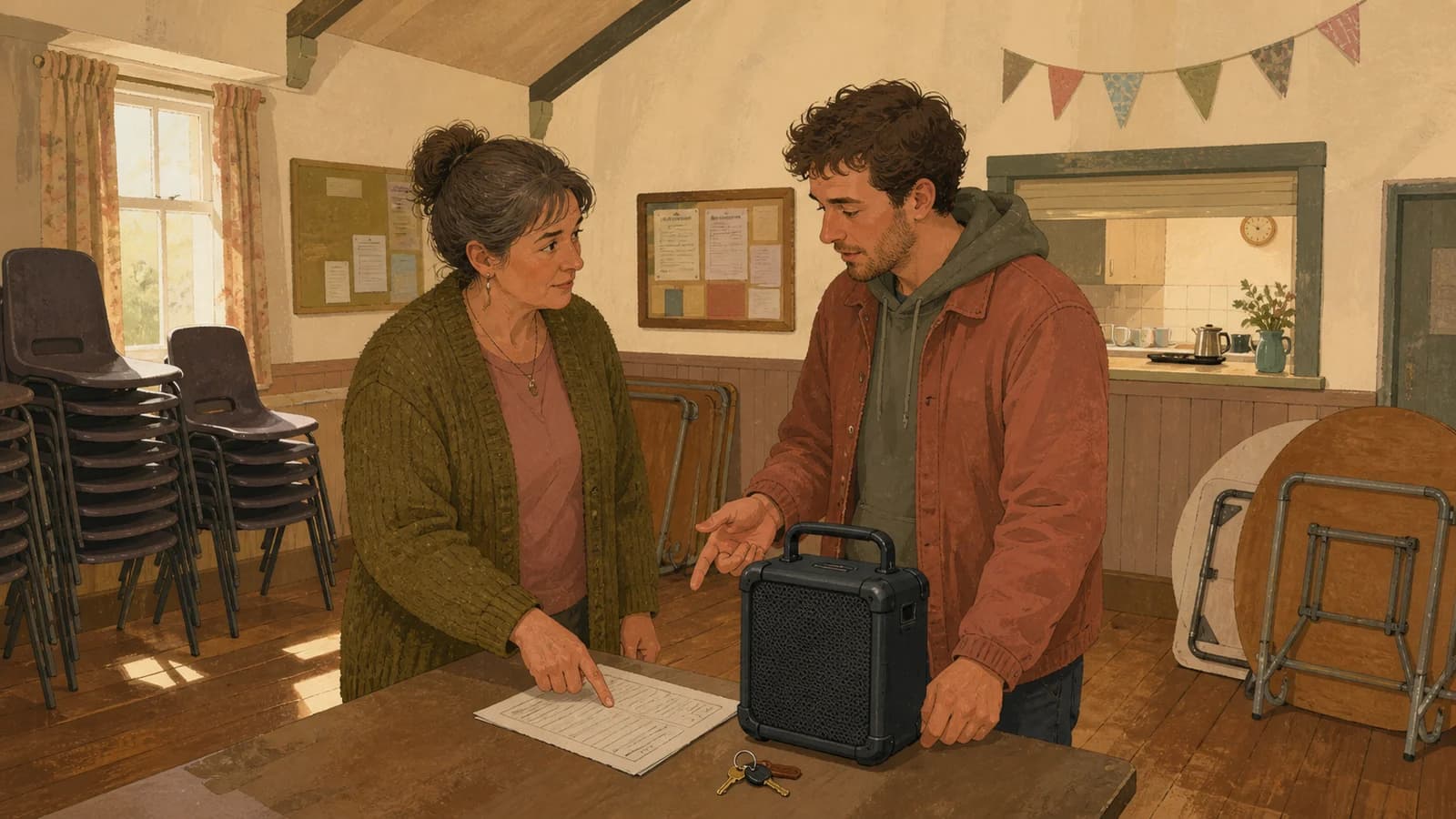
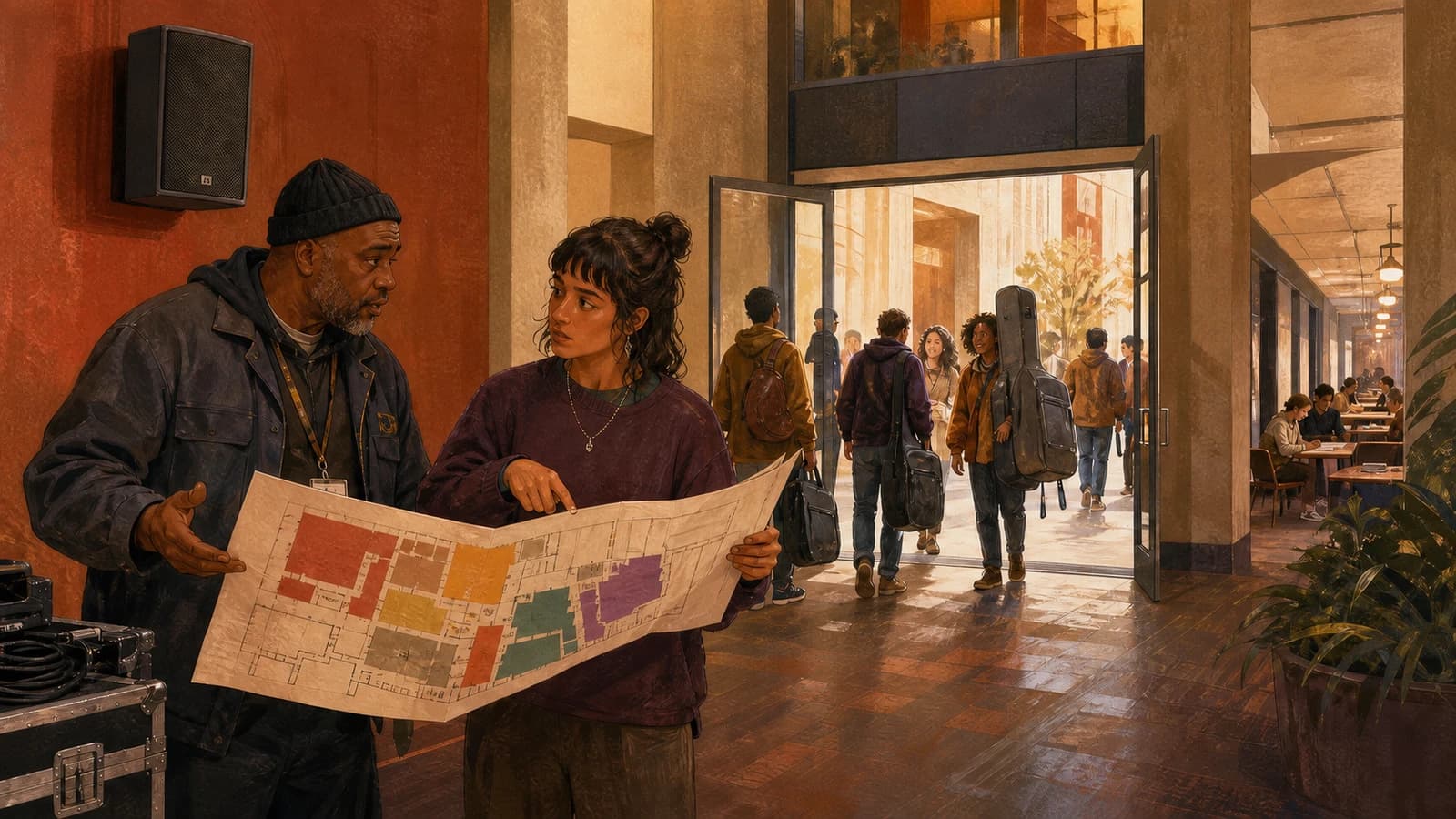
Illustration: a venue music handover.
Work one room change through the inventory
Example: an atrium is used for ordinary background music in the morning and a society reception in the evening. Keep the room identifier, then create a separate activity row for the reception. Record the organiser, supplier, source, audible areas and intended start and stop times. Do not overwrite the ordinary background row and lose the distinction.
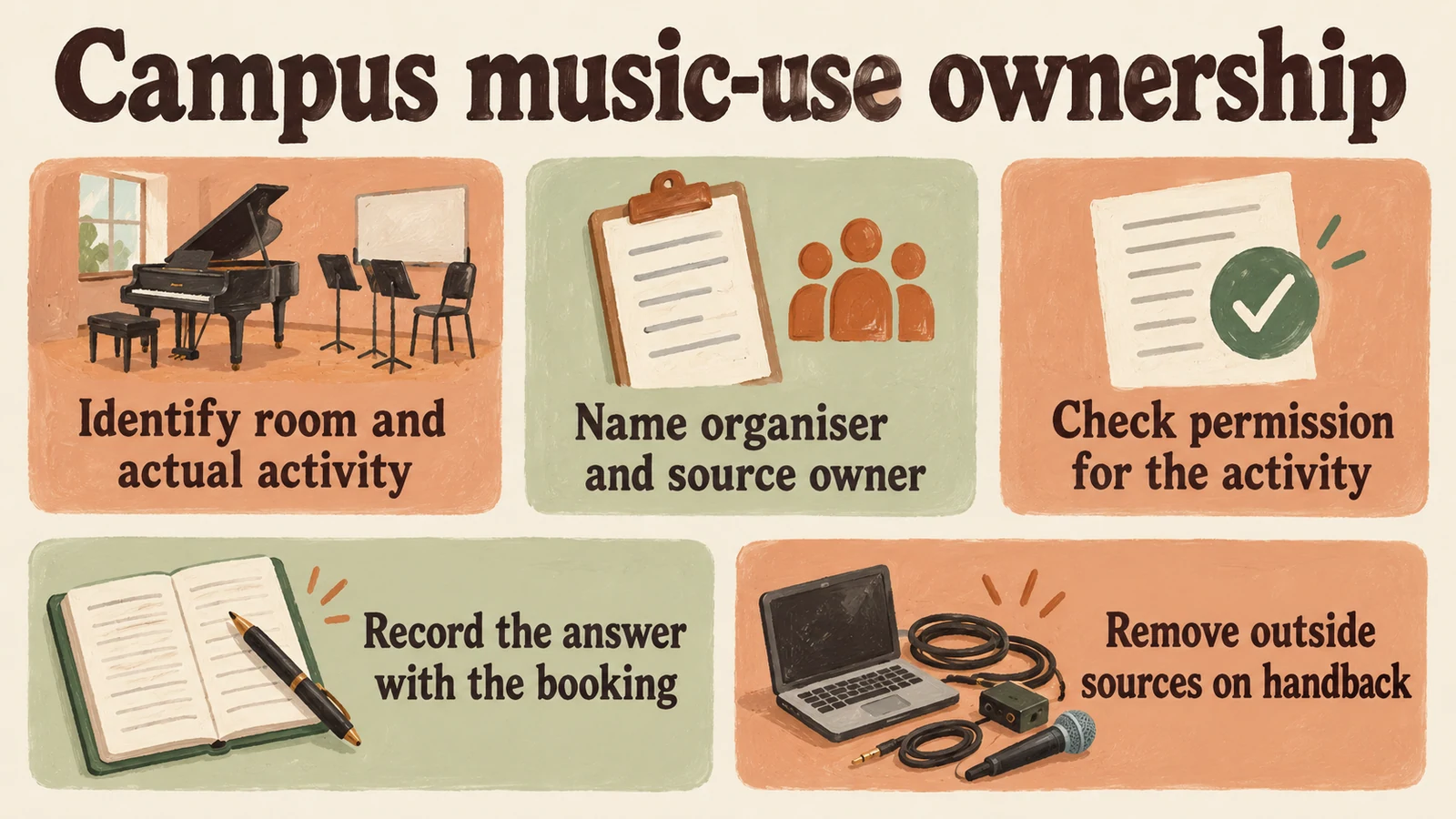
If a visiting DJ replaces the planned background source, mark that source as awaiting confirmation and send the change to the responsible campus contact. The approved morning source does not establish permission for the evening supplier. Keep the response with the booking and tell facilities which source to remove afterwards.
For rooms used by outside groups, the village-hall hirer checklist offers a useful administrative comparison. Its community-building responsibility table does not determine a university's licensing position.
Use one declaration row per space and activity
| Space or activity | Day-to-day owner | Music source | Use type | Specialist check or evidence |
|---|---|---|---|---|
| Reception or atrium | Estates or facilities | Approved background service | Ambient background | Area, hours and source record |
| Students' union bar | Union operator | Background, TV or event source | Mixed | Each source declared separately |
| Society room | Society and room booker | Personal device or performer | Rehearsal/event | Society declaration and permission route |
| Lecture theatre screening | Department or organiser | Film/TV programme | Public screening | Screening rights and event conditions |
| Theatre production | Production lead | Recorded cues or performers | Dramatic/live use | Specialist rights check |
| Graduation or open day | Events team | PA, walk-on or background | Featured event | Running order and source owner |
The current PPL PRS university guidance asks campuses and students' unions to establish responsibility and declare background, event, society and screening uses. Follow the current guidance for the institution's actual activities. This inventory is administrative preparation, not legal advice.
Make ownership explicit at room booking
Add four music fields to the booking process: source, use type, audible areas and responsible person. “AV required” is too vague. A lecturer's embedded clip, a society DJ, a live band and reception background music take different routes.
If a room changes hands during the day, record the handover. The morning conference should not leave a personal account or video source active for an evening lecture.
Keep the common-area plan narrow
For an atrium, reception or approved social area, define the background-only boundary. State what is deliberately excluded: society playlists, screenings, performances, teaching material, live acts and third-party uploads.
Sonosfera provides one independent stream per zone, daypart scheduling, venue-mood playlists and phone control of each zone's vibe and volume. Those controls can support named common areas after the institution confirms the use. The catalogue terms license Sonosfera catalogue playback at the locations on your active plan, including background music and instructor-led classes. Music from society devices, films, television, DJ libraries, theatre productions and live performers remains outside that catalogue licence.
For performances in a shared building, use the theatre foyer checklist to separate front-of-house background from production music. Check current UK plans only for the background zones that remain in the inventory.
Use the staff music policy template to record which colleagues may change ordinary background sources.
Add a weekly exception review
For ordinary common areas, the business-type directory lets you compare room-specific music guides without treating the whole campus as one event venue.
Facilities and the students' union do not need a meeting about every ordinary day. They do need a short review of exceptions:
- new society or public event;
- temporary outdoor speaker;
- screening or production;
- visiting supplier source;
- room used outside its ordinary hours;
- activity whose owner is still blank.
Pause only the uncertain row, not the whole campus. Route it to the relevant rights holder, authority or internal specialist and keep the response with the booking.
Sonosfera catalogue scope
For Sonosfera music at the locations on an active plan, no PPL PRS licence is needed under the catalogue terms. The plan covers its own catalogue for background music and instructor-led classes. Society devices, film soundtracks, DJ libraries, theatre productions and live performers are outside that catalogue licence and need their own permission.
Frequently asked questions
Who owns music used by a student society?
Do not infer ownership from the room key. Record the society, room booker and university contact, then confirm who is responsible for the actual source and use.
Should teaching and public events share one rule?
No blanket rule is safe. Audience, purpose, source and access can differ. Put the real activity in the ledger and ask the appropriate current question.