
Short answer: To improve restaurant acoustics, identify the noise source and how sound travels before buying treatment or turning up the music. Check the dining room with music off, with music on and during representative service. That separates an intrusive soundtrack from noisy equipment, sound lingering in the room and sound passing between spaces.
The first useful question is not "Which panels should we buy?" It is "What prevents a guest at this table from hearing the person opposite?" A good diagnosis should lead to a specific change and a way to check whether it helped.
Is the problem the music, the room or both?
Listen at the same tables with the music off and on before deciding that the playlist or the building is responsible. If a troublesome sound remains with music off, identify it rather than trying to mask it. If the problem appears when music starts, check the programme, level and speaker coverage. During a busy service, repeat the observations without assuming an empty-room result will hold.
Choose a few meaningful positions: a table beside the bar, a central table, a booth, the host point and any table already mentioned in complaints. Write down what is difficult to hear and what competes with it. Use specific descriptions such as clattering crockery, a persistent fan, nearby speech or a speaker directly overhead.
| Listening condition | Useful observation | Next investigation |
|---|---|---|
| Music off before service | A machine or service station dominates | Reduce or separate that source where practical |
| Music on before service | Some seats are much louder than others | Check level, placement and coverage |
| Busy service, music low | Speech and clatter remain difficult | Investigate room acoustics and service noise |
| Adjacent room or neighbour affected | Sound crosses a boundary | Investigate transmission paths and isolation |
These observations narrow the question. They do not replace an acoustic survey or establish a noise exposure assessment.
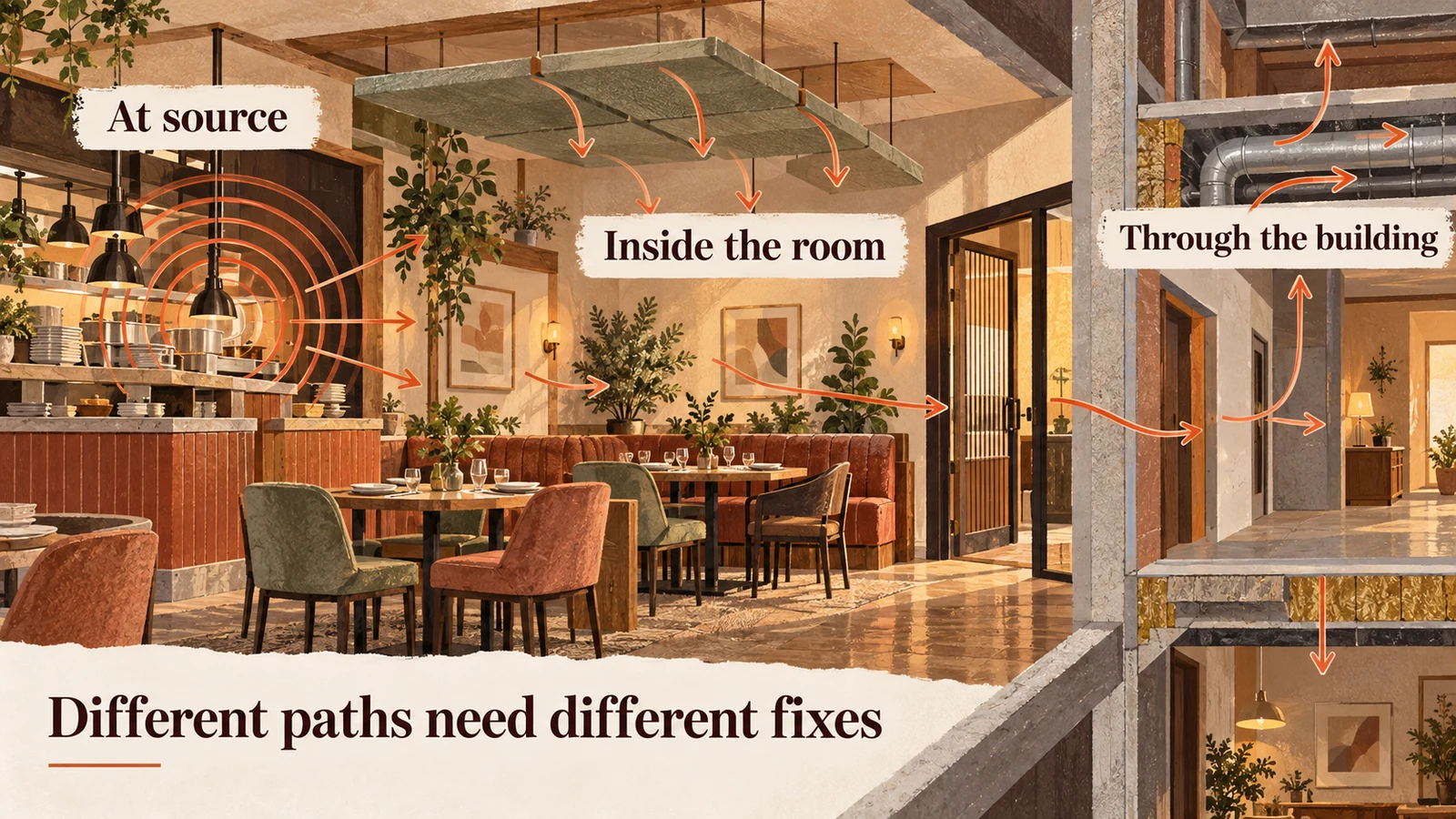
Absorption and sound isolation solve different problems
Absorption addresses sound reflected within a room; isolation addresses sound passing between spaces. Buying a soft-looking wall finish does not establish either result. Ask which sound path a proposed product is intended to change and what evidence supports that use. The Health and Safety Executive's workplace design guidance distinguishes reflected sound from direct sound and discusses layout, barriers and absorbent treatment.
For a dining room, this means an acoustic panel proposal should explain the reflected-sound problem it addresses. A complaint from an upstairs resident needs a separate investigation of how sound travels through or around the building. Both problems may exist, but they are not interchangeable.
The HSE also notes that absorbent treatment on walls and ceilings affects reflected sound rather than the direct path. Keep that distinction in the brief. A guest sitting beside a noisy service station may still need the source moved, maintained or screened appropriately, even if the room's reflections are improved.
Reduce avoidable noise at the source
Start with operating and maintenance changes that address the identified sound, then assess whether treatment is still needed. A rattling fitting, noisy appliance, scraping chair or badly positioned crockery station gives you a concrete issue to investigate. Record the source, location and conditions in which it becomes intrusive. Refer equipment faults to the responsible contractor instead of disguising them with louder music.
Review the service route too. Ask whether clearing and sorting can happen farther from the most affected tables, whether doors and fittings need attention, and whether the current layout places quiet dining beside the busiest activity. Ask the venue manager to check access, hygiene and building requirements before adopting a change.
Keep the scope realistic. A small operational adjustment may address a local clatter problem; it does not prove that a reflective room has been treated. Repeat the same listening check after the change so you know which complaint, if any, improved.
What should you ask an acoustic specialist to measure?
Ask the specialist to investigate the actual complaint, room use and sound paths, then propose suitable measurements and acceptance criteria. Do not start by demanding a universal reverberation time or background level copied from another venue. Give them the room dimensions, finishes, occupancy pattern, music system, adjoining spaces and the observations from your listening checks. The right brief makes it easier to distinguish competing causes.
Useful questions include:
- What is the dominant cause of difficulty at the affected tables?
- Does the assessment need occupied as well as unoccupied conditions?
- Which surfaces or sound paths matter most here?
- What change is expected from the proposed treatment, and how will it be checked?
- What installation, cleaning, fire-performance and building constraints apply?
- What remains outside the proposal, including noise reaching neighbours?
Reverberation time describes how sound decays in a room. It is one useful measurement, not a complete description of conversation, source noise or sound transmission. A phone recording can help identify a rattle or preserve an incident, but it should not be treated as a certified measurement of the room's acoustic performance.
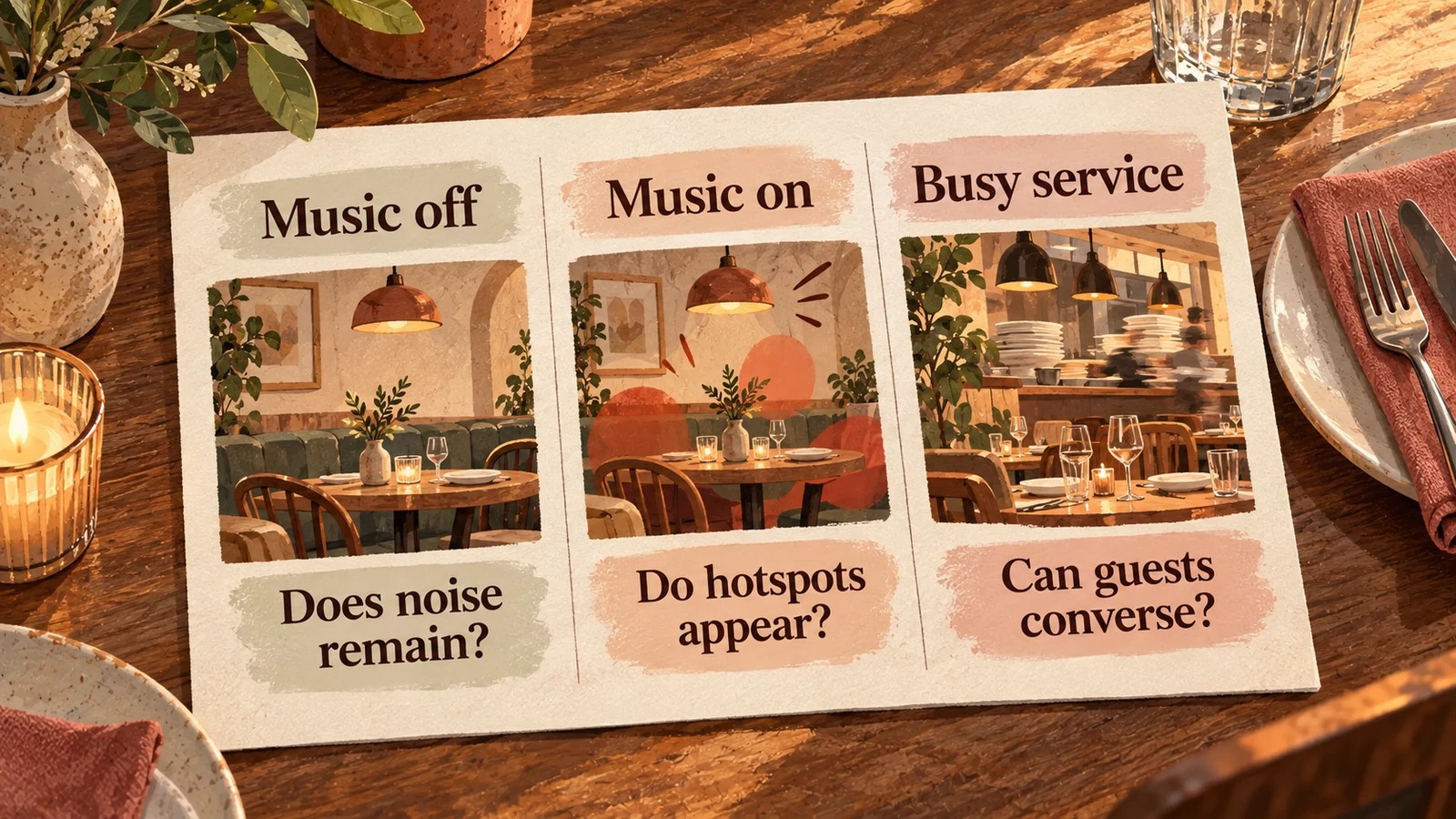
Keep music decisions separate from treatment claims
Choose background music and its level after identifying what the room can support. A denser track may make a complaint more noticeable, but changing genre cannot establish that a building defect is fixed. Likewise, a quieter selection does not prove that equipment noise or sound transmission is acceptable. Keep each observation attached to the change you actually made.
Use the background music volume guide for the operating level and the instrumental or vocal music guide for programme choice. If nearby and distant seats hear very different levels, investigate speaker placement and coverage rather than treating every complaint as a room-wide volume problem.
Sonosfera provides its own catalogue of business background music. It can be part of the programme you choose for the room; a subscription is not acoustic treatment or a sound-isolation service. Read the catalogue terms, explore the Sonosfera for restaurants and compare current UK plans when the music decision is the next useful step.
Make the result checkable at the same tables
Agree how a proposed improvement will be assessed before work starts, then return to the positions and conditions in the original brief. Record what changed in the room and what changed in service. If several things moved at once, preserve that limitation instead of attributing the entire result to the panels, the playlist or the volume setting.
The handover should name the approved music setting, the affected positions and any issue still awaiting investigation. A useful outcome is specific: the agreed acoustic measurements meet the design brief, and the operator's repeated service checks no longer reproduce the identified difficulty. Sales, reviews and guest retention are separate business outcomes; a room modification alone does not establish them.
If staff may face harmful noise exposure, follow the separate HSE noise-at-work guidance and obtain the appropriate assessment. Guest comfort and workplace duties need their own evidence. Finish with a room you can operate and a decision the next manager can understand.