
Short answer: Active speakers have amplification built into the speaker system; passive speakers require a separate power amplifier. For a small venue, start by locating power, identifying the available audio output and deciding where faults will be serviced. Those practical constraints make the choice clearer than a claim that either speaker type always sounds better.
Terminology needs care. Retailers often use “active” and “powered” interchangeably, while a technical description may distinguish an active crossover and amplification for individual drivers. Dynaudio's explanation makes that distinction. Read the actual input and amplifier specification rather than choosing from the label alone.
Trace power and signal as separate paths
Draw where the music signal travels, then mark where electrical power is needed. In a powered arrangement, the speaker contains its amplifier. In a passive arrangement, amplification sits before the speaker cable. Yamaha's speaker guide explains these basic arrangements. The physical path is the starting point; streaming, wireless control and catalogue permission are additional questions.
| Check | Powered speaker arrangement | Passive speaker arrangement |
|---|---|---|
| Amplification | Inside the powered system | External amplifier or powered mixer |
| Supply power | Confirm power at each powered unit | Confirm power and ventilation at the amplifier |
| Audio connection | Use an input compatible with the source or mixer output | Use the correct amplifier output and speaker cable |
| Expansion | Check supported signal linking and control | Recheck channel loading, amplifier capability and wiring |
| Fault access | Plan access to the powered unit | Plan access to the amplifier and installed speakers |
| Complete quote | Include power, signal, mounting and control | Include amplifier, speaker runs, mounting and control |
Ask the installer to label the path with actual model numbers. A diagram that only says “music to speakers” does not show whether you already have the necessary amplification, whether the outputs are compatible, or where staff can safely adjust the level.

A socket that fits does not establish compatibility
Check the signal level and function of each connector before connecting equipment. A powered speaker's input and a power amplifier's speaker output perform different jobs. Use the manufacturers' connection instructions for the exact models. Do not put an amplified speaker output into an ordinary line input unless the equipment documentation explicitly describes a suitable interface.
This is where a second-hand purchase can become confusing. A speaker cabinet may resemble another model while requiring a different input. Photograph the rear label and connectors, identify its manual and establish the path before buying adapters. The connector's shape alone does not tell you everything about the signal it carries.
If the source is a phone, computer or network player, identify its audio output too. It might require a compatible input, interface or receiver before either speaker arrangement can use it. A powered speaker is not automatically a wireless streamer, and a passive speaker is not automatically incompatible with a streaming service.
Put power access into the purchase decision
Choose an arrangement that can be installed properly where the speakers need to go. A powered speaker may simplify amplification choices, but its supply and audio path still need planning. A passive arrangement can centralise amplification while introducing speaker runs and channel-loading decisions. Neither removes mounting, cable routing or maintenance requirements.
Consider the room before accepting a convenient shelf position. Is the intended location appropriate for coverage? Can the unit be serviced? Are leads protected from customers, cleaning and moving furniture? Ask a qualified installer to address mounting and electrical work rather than making an extension lead part of the permanent design by accident.
Use the speaker-placement guide to describe coverage problems. It answers where people hear the music; this guide answers how the selected speakers are powered and connected. Keeping those questions separate helps avoid changing an entire system to solve a local placement issue.
Compare complete quotes with the same room brief
Compare what each proposed installation includes, not the price of a speaker cabinet against the price of a complete system. Give suppliers the same room, desired coverage, music source, control requirements and service constraints. Ask them to identify exclusions so an apparently cheaper quote does not leave necessary work for someone else.
Include amplification, mounting, power provision, signal and speaker cables, source interfaces, commissioning and support. Ask what can be reused from the existing installation and what evidence establishes compatibility. An existing amplifier can be useful; an unidentified amplifier is an unanswered question, not a saving you can safely count.
Avoid a universal price verdict. The answer changes with the models, installation and equipment you already own. For a small temporary setup, fewer separate boxes may be valuable. For a fixed venue, accessible central equipment may matter more. Assess those advantages against your own constraints rather than generalising from a home-listening recommendation.
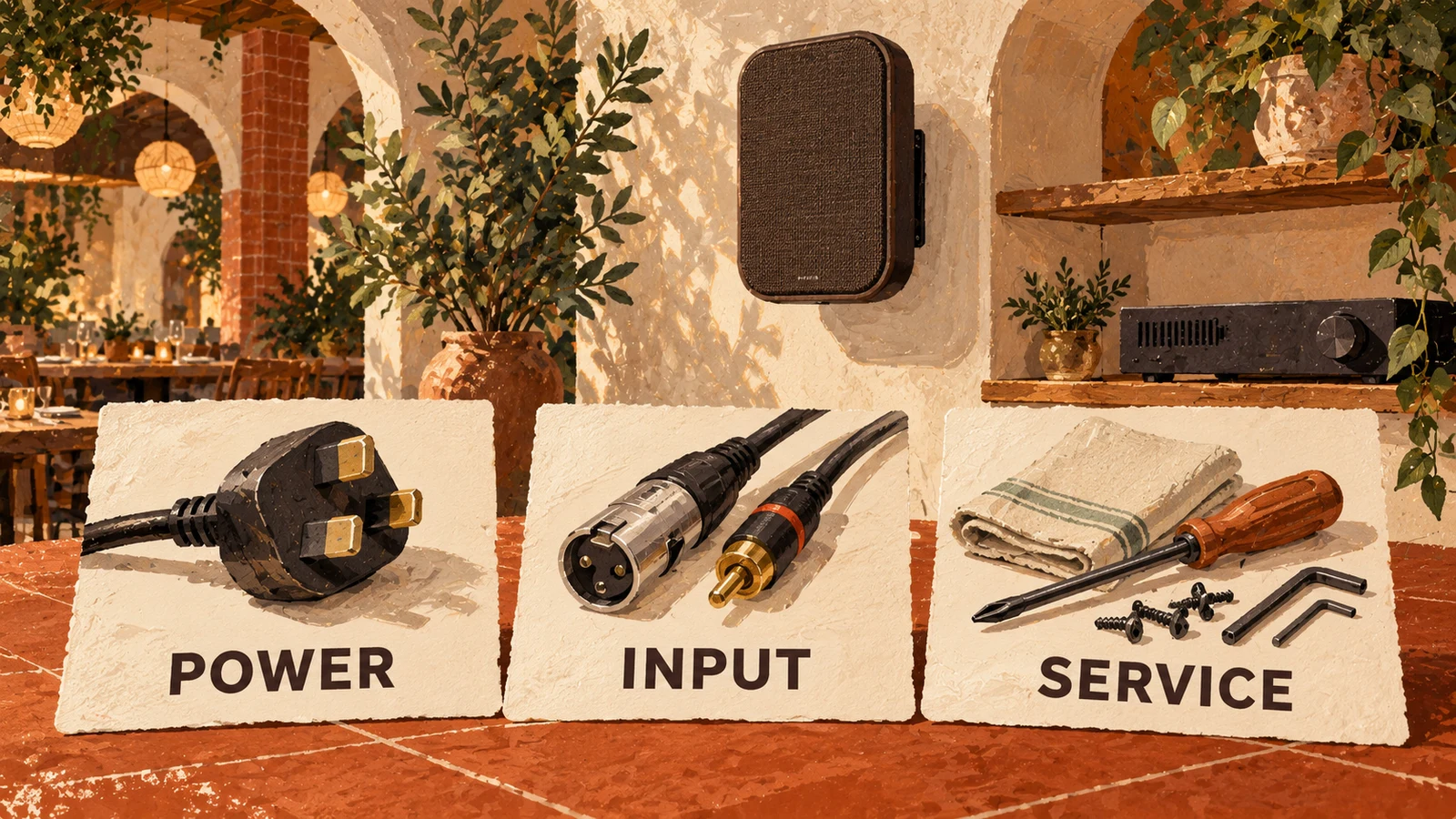
Expansion changes the checks you need
Adding another passive speaker can change the load seen by an amplifier channel. Adding a powered unit raises different questions about signal linking, power and control. Yamaha's expansion guidance describes both arrangements. Do not copy a connection from one type into the other without checking the model instructions.
For conventional passive speakers, use the impedance guide before changing the load. For rooms that need separate programmes or level control, describe the job with the multi-zone guide. More cabinets and more independent zones are different requirements, so ask the supplier to address each explicitly.
Also ask what happens when a component fails. Can staff stop the affected area? Can the installer access the failed unit without disrupting the whole venue? Is a replacement compatible with the remaining system? A clear service plan is more useful than assuming that either built-in or separate amplification is inherently easier to maintain.
Keep the music service separate from the speaker purchase
Choose the source after checking both its permitted use and its actual connection to the system. Active and passive speakers can both sit at the end of a suitable background-music path; neither supplies a catalogue or a music licence by itself. The complete setup guide joins those decisions into an operating plan.
Sonosfera provides background music from its own catalogue under its terms, rather than amplifiers or installation services. Listen to the catalogue and use the business-type directory to find the relevant venue guidance. Check the current UK plan if the music suits your room, then confirm playback through the equipment you intend to use.