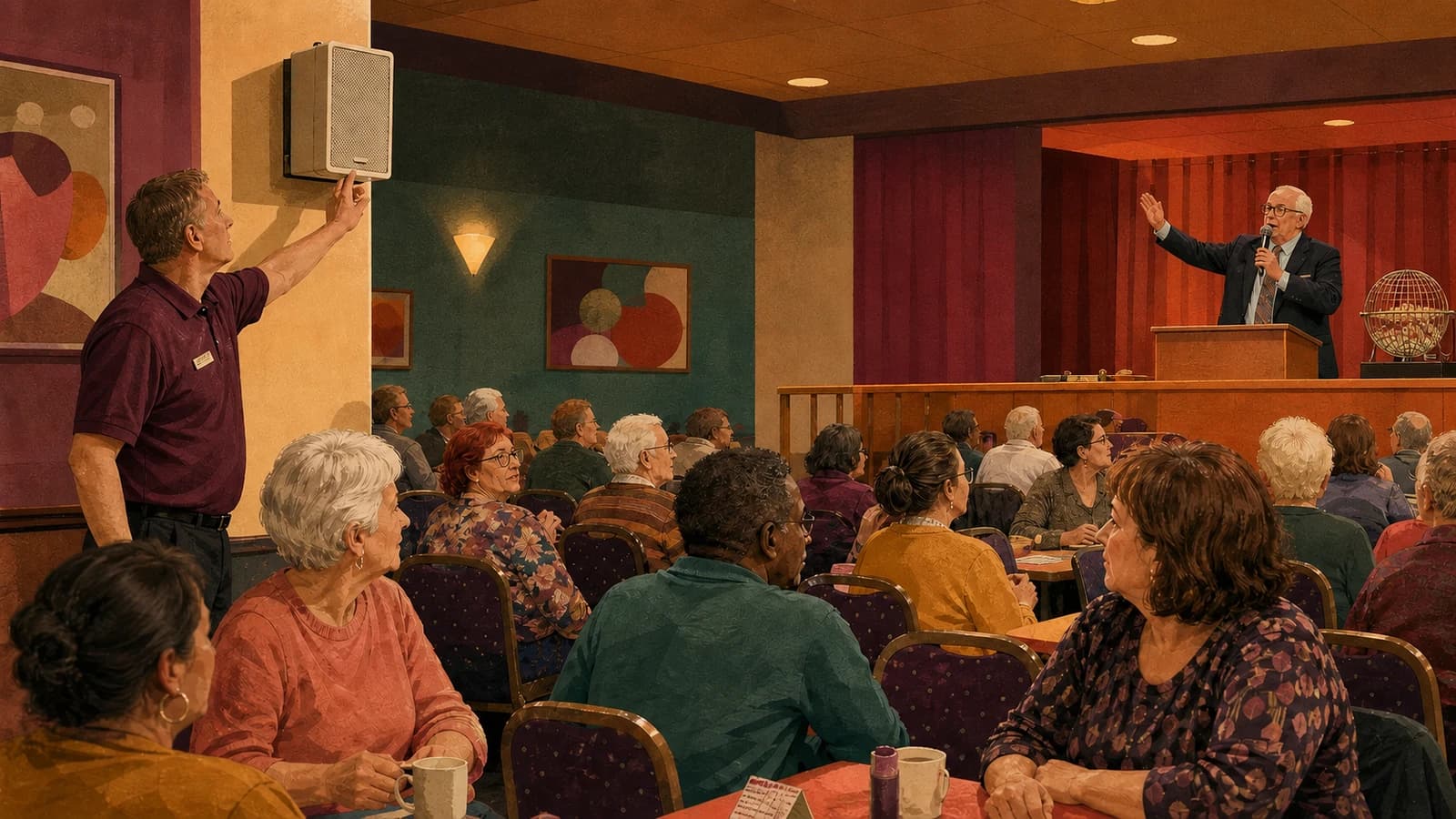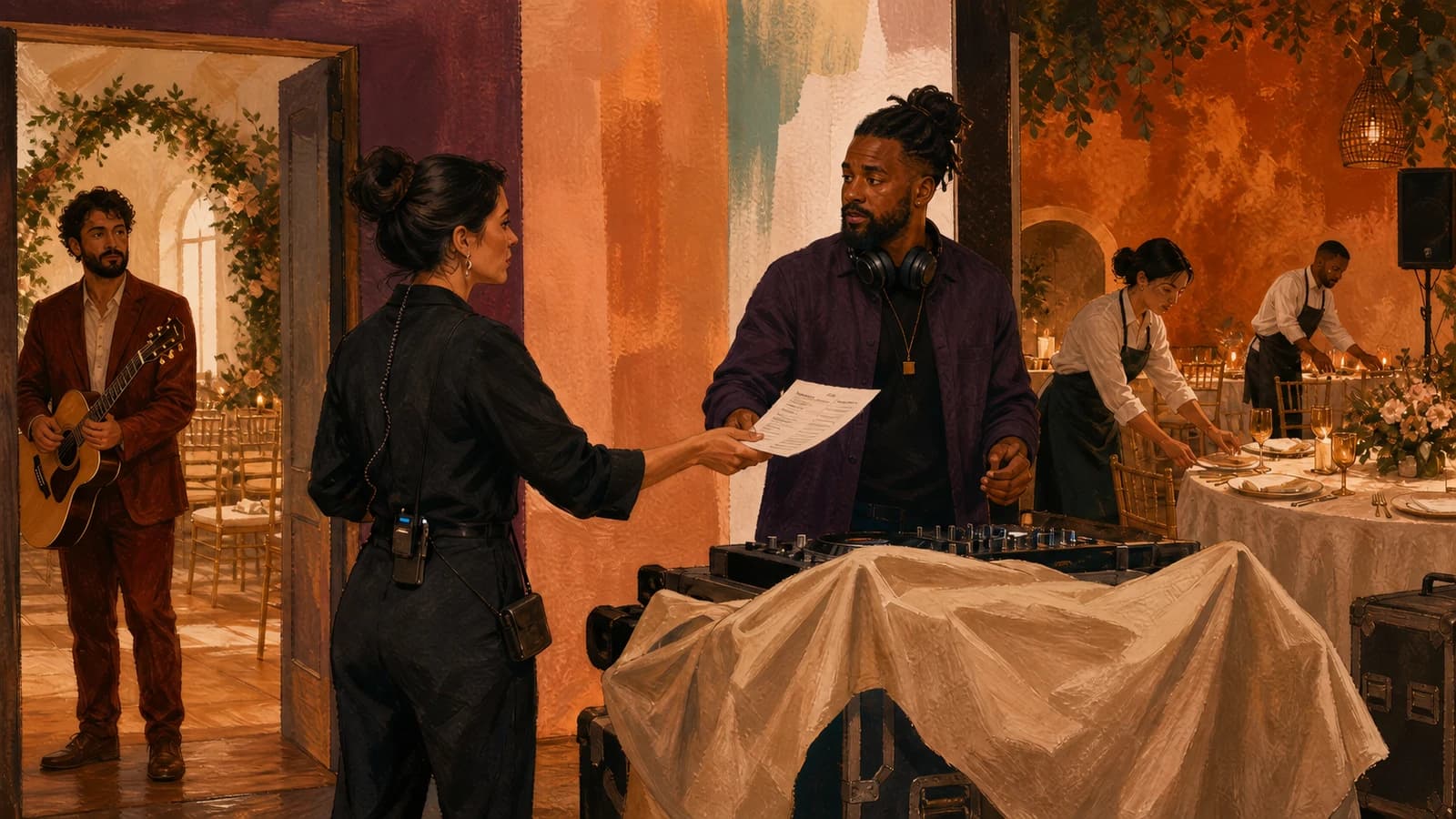
Short answer: A wedding venue should put every source on one running order and name the handover point between them. House background music, ceremony cues, speech microphones, live musicians and the DJ remain separate even when guests experience them as one day.
Illustration: a venue music handover.
Add a source-control timeline
| Moment | Source | Operator | Handover confirmation |
|---|---|---|---|
| Guest arrival | Approved house background | Venue coordinator | Ceremony lead receives control |
| Ceremony | Supplier or venue cue source | Ceremony operator | All cues complete and source stopped |
| Drinks/reception | House background or live performer | Venue/event lead | Speech operator receives silence |
| Speeches | Microphone/PA | AV or venue lead | DJ/live supplier receives control |
| Evening party | DJ or band | Supplier | Venue receives rooms back |
| Close | Ordinary venue source or silence | Closing manager | Temporary equipment removed |
The current NADJ wedding planning guide recommends aligning timing, access, background music, speeches, first dance, restrictions and a day-of contact. Use those discussions to build the venue-side timeline. It is operational guidance, not proof that every music or event permission is covered.
For Canadian event venues, pair the handover with the SOCAN and Entandem permission checklist.
Where a community hall is hired for the reception, the committee-and-hirer music checklist helps keep practical handover and licence responsibility distinct.
Make each handover spoken and physical
The outgoing operator stops their source. The incoming operator confirms their equipment and rooms. The coordinator listens at the doorway before saying the handover is complete.
Do not let a ceremony phone remain connected during the drinks reception or allow house music to compete with a speech microphone. Personal accounts should leave with their owners.
Keep the ordinary plan underneath the wedding plan
For approved venue background areas, Sonosfera provides independent streams, daypart scheduling and phone control of each zone's vibe and volume. Those controls can support arrival, reception or breakfast zones where the venue has confirmed the use.
It does not supply a couple's requested external recordings, uploads, live performers, DJ libraries or speech systems. Keep those sources with their named operators and check the catalogue terms. If different rooms need different background streams, use the multi-zone guide. Check current UK plans for the house background zones.
Use a supplier handback check
For the ordinary house background layer, compare the relevant room guides in the business-type directory. Keep the ceremony and supplier sources on their own rows.
- ceremony and DJ sources stopped;
- live and AV equipment disconnected by its owner;
- personal accounts removed;
- reception, ceremony and outdoor areas walked;
- ordinary venue setting or silence restored;
- changed timing or source logged.
Frequently asked questions
Who controls music during room turnaround?
Name the coordinator or duty manager. Turnaround is a real programme state, not empty time between suppliers.
Can I let the DJ take over the house system?
Only if the venue and DJ agree the technical, contractual and permission boundaries in advance. Do not improvise the connection on the day.
This applies to Sonosfera's own catalogue at the locations on your plan. No PPL PRS licence needed for Sonosfera music under an active plan. Music from other sources needs its own licence. See the catalogue terms for the locations and uses covered by your plan.