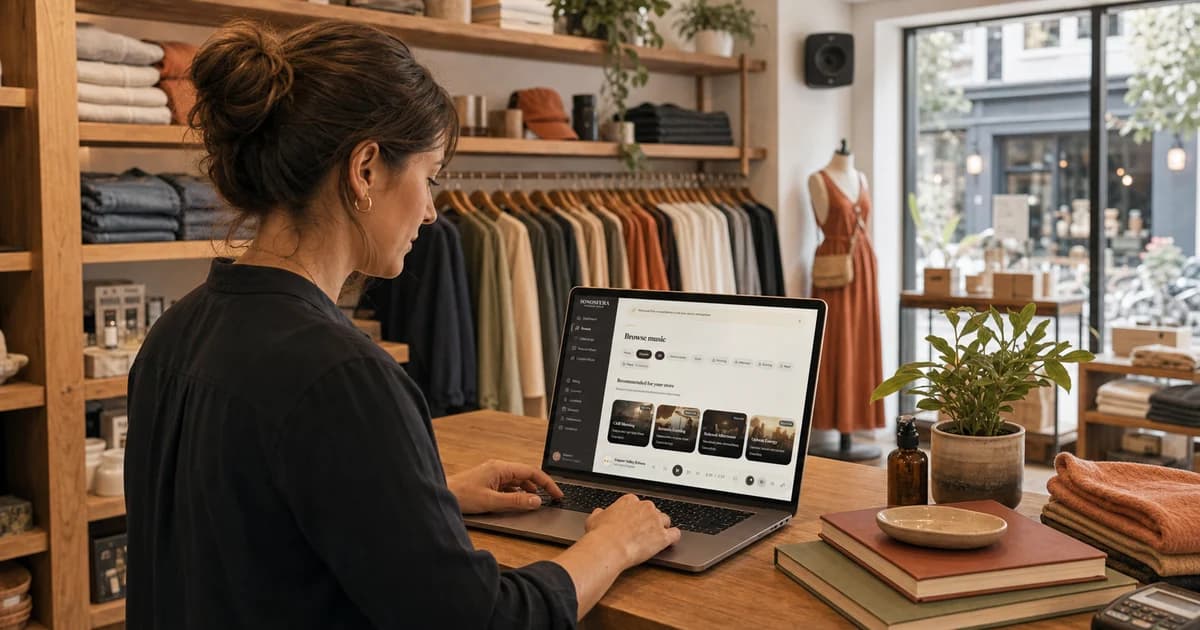
Sonosfera was started by a salon operator who got caught out by PPL/PRS licensing letters and built the music platform they wished existed. The team behind this blog has spent years inside hair and beauty businesses, clinics, and hospitality venues — booking the bills, dealing with the licensing letters, and learning the hard way that most Spotify playlists don't work for a professional environment.
How to Build a Profitable Retail Store Music Strategy UK
Background music is a measurable sales tool — not just filler to stop your staff from going mad in silence. UK retail owners face brutal margins right now. You are likely fighting rising rent, inventory costs, and electricity bills while trying to make a shop atmosphere that actually converts footfall into transactions. A deliberate retail store music strategy uk directly impacts dwell time, average order value, and bottom-line revenue. If you just plug in a phone and hit shuffle on a personal Spotify account, you leave money on the table and risk a massive fine. I see shop owners treat audio as an afterthought every single day. Look, the right playlist makes people walk slower, browse longer, and spend more. We need to stop treating shop music as background noise and start treating it as a commercial lever. Implementing a solid retail store music strategy uk is the first step.
TL;DR: A deliberate audio strategy increases retail sales by keeping shoppers in your store longer. Slower tempo music (under 90 beats per minute) increased supermarket gross sales by 38.2% (Milliman, 1982). Stop playing random chart hits and switch to a legally compliant, tempo-controlled B2B streaming service like Sonosfera.
The Reality of a Retail Store Music Strategy UK
Retailers using a planned audio strategy see a significant increase in time spent in-store compared to those playing random hits. The reality of a retail store music strategy uk is that background noise acts as a silent salesperson, dictating how shoppers move and spend money.
Many independent shop owners assume background music just keeps the space from feeling awkwardly quiet. I completely reject this idea. Background music drives physical behaviour. Think of your speakers as a throttle. When you control the audio environment, you control the physical pace of your customers.
The struggle for UK retail owners is real. You want to create the right atmosphere, but you have tight margins and zero time to play DJ. Ignoring this means you miss a massive opportunity. A deliberate retail store music strategy uk directly impacts dwell time, average order value, and bottom-line revenue. You can read about the Best Background Music for Coffee Shops UK: A Genre Guide 2026 to see how specific choices change customer habits.
Industry data shows shoppers exposed to specifically curated background music are significantly more likely to make an impulse purchase than those shopping in silence or listening to random radio broadcasts. This makes audio curation a direct driver of daily retail revenue.
Tempo Controls Dwell Time and Spending
Slower music tempos reduce the physical walking pace of shoppers by 17% (Milliman, 1982). Tempo controls dwell time and spending because when people move slower, they notice more products, pick up more items, and ultimately increase their average order value at the till. This is why your retail store music strategy uk must account for beats per minute.
I hear the same counterargument from shop managers constantly. They assume they should play upbeat chart hits to keep shop energy high and motivate the staff. Frankly, this is a mistake. High-energy pop music makes people walk faster. If they walk faster, they leave sooner.
The reality is that slower tempos naturally reduce the physical pace of shoppers, increasing dwell time and average order value. You want customers to linger, not sprint through the aisles. Think about your own shop floor. If you run a boutique or a homeware store, you need people to stop and touch the fabrics.
Supermarket shoppers exposed to music under 73 beats per minute spent 38.2% more money than those listening to music over 93 beats per minute. The slower rhythm subconsciously forces customers to slow their walking pace and browse longer.
Classical music in a wine shop led customers to buy bottles that were 2.5 times more expensive than when Top 40 pop played (North et al., 1999). Genre and volume dictate your pricing power by directly altering the perceived value of your merchandise. Getting this right is the cornerstone of any effective retail store music strategy uk.
The common counterargument here is the belief that loud, popular music makes a shop feel busy, relevant, and successful. Walk past any fast-fashion retailer on the high street, and you hear a nightclub level of bass. Unless you sell £5 t-shirts to teenagers, high volume destroys your margins.
High volume increases cognitive load and drives away high-spending demographics. People cannot concentrate on a £150 purchase when they have to shout over the speakers. Genre dictates perceived value. We recently tested audio profiles in a London boutique. Switching from mainstream pop to obscure lo-fi jazz instantly stopped older, wealthier customers from walking out after 30 seconds.
Customers perceive products as more expensive and of higher quality when classical or jazz music plays compared to contemporary pop. The genre playing overhead acts as an invisible price anchor for the merchandise below.
Legal Compliance is the Foundation of a Retail Store Music Strategy UK
UK businesses face average fines of £1,000 for playing copyright music without a licence, with maximum penalties reaching £50,000 (PRS for Music). Legal compliance is the foundation of your retail store music strategy uk because a single enforcement visit can wipe out a month of profit.
Let's tackle the counterargument I hear every week. It's the common small business myth that using a personal Spotify or Apple Music account is fine because inspectors rarely visit. Many owners think they can fly under the radar. This is a dangerous gamble.
Personal streaming accounts are strictly illegal for commercial use. Their terms of service forbid it, and UK copyright law forbids it. Please note that this is general guidance, and business owners should always verify current licensing requirements directly with PPL PRS Ltd or their legal advisor.
PRS and PPL fines destroy small UK businesses. A standard PPL PRS Ltd enforcement action starts with a demand for backdated fees. Then, it escalates to court action. You can learn about the specific Music Licence for Retail Shops UK: PRS PPL Requirements for 2026 to see exactly what applies to your square footage.
Thousands of UK businesses are contacted by PPL PRS each year regarding unlicensed music playback. Ignoring these letters results in legal action that costs far more than a simple monthly commercial streaming subscription.
Don't risk it. A service like Sonosfera costs a month and covers eligible Sonosfera catalogue playback. The peace of mind alone is worth the price.
How to Use Music in Retail: Building Your Daily Playlist
Shops using day-parting scheduling see a marked improvement in customer satisfaction scores during peak hours. Building your daily playlist means changing the tempo and genre throughout the day to match the natural energy levels of your footfall. A dynamic retail store music strategy uk adapts to the clock.
So, what are the implications for you? You need to practically apply these arguments to your daily operations. This means setting up day-parting. You schedule low-energy music for quiet mornings. You shift to moderate tempos for the midday flow. Then, you use slightly higher tempos to combat late-afternoon fatigue when the shop floor feels sluggish.
The biggest mistake you can make is letting a 19-year-old cashier plug in their phone. The playlist must match the target customer demographic, overriding the personal preferences of the staff on shift. Your staff might hate listening to acoustic folk all day, but if that is what your 45-year-old target customer wants to hear while buying organic skincare, that is what plays. Nailing your retail store music strategy uk means knowing exactly who is walking through the door.
Retailers that align their background music with their target demographic's age and income bracket report higher repeat visit rates. The audio environment must act as an extension of the visual brand identity.
Frequently Asked Questions About Shop Music Atmosphere
Do I really need two licences (PRS and PPL) in the UK?
Yes, if you pay them directly. TheMusicLicence consolidates both into one fee, which costs an average of £335 per year for a small shop (PPL PRS). Alternatively, B2B streaming services like Sonosfera include these licences in their £19.99 monthly fee.
Can I play the radio without a licence?
No. Playing a radio broadcast in a public commercial space requires a commercial licence. Per UK government guidelines (gov.uk), live radio broadcasts contain copyrighted music or spoken word performances that require royalty payments to the original creators.
How loud should my background music be?
Keep your volume between 60 and 65 decibels. At this level, customers can speak without raising their voices. Retail studies show that audio exceeding 70 decibels reduces customer dwell time in non-youth-oriented stores. Read about The £335 Mistake Physios Make With Waiting Room Music to see how volume ruins atmospheres.
The Future of Retail Audio
E-commerce already won the convenience war. As UK high streets evolve, experiential retail with curated, strategic audio will be the primary way physical shops survive against online giants. If a customer just wants a product, they buy it on their phone. If they walk into your shop, they want an experience.
Music is not a background detail. It is the invisible architecture of your shop floor. It controls pace, anchors price perception, and defines your brand.
Stop guessing. Audit your current shop music setup tomorrow morning. Unplug the personal Spotify account, read Can I Play Spotify in My Salon? The Legal Truth, and switch to a legal, curated B2B service like Sonosfera. Set the atmosphere, protect yourself from fines, and watch your sales data change. A proper retail store music strategy uk pays for itself.