Best Business Music Services UK 2026: Prices + Licensing (US & UAE)
Compare business music services for the UK, US and UAE in 2026: real monthly prices, and whether each covers your PPL/PRS, ASCAP/BMI/SESAC/GMR or UAE licensing.
The monthly price is the wrong headline. What decides your total bill is whether a service covers your public-performance licensing or just hands you music you still have to license.
The licensing body changes at the border — PPL/PRS in the UK, the ASCAP/BMI/SESAC/GMR PROs in the US, and two newly licensed societies (EMRA and Music Nation) in the UAE.
Consumer Spotify, Apple Music and YouTube are personal-use only in all three markets, whatever plan you are on.
A UK small-shop licence runs to £450.99 + VAT a year, so a £15/month own-catalogue app is the cheap route only if you play nothing else.
Playing only Sonosfera's own AI-generated catalogue does not require PPL/PRS, the US PROs, or a UAE society licence for that music, and paid accounts get certificate-ready records.
Sonosfera was started by a salon operator who got caught out by PPL/PRS licensing letters and built the music platform they wished existed. The team behind this blog has spent years inside hair and beauty businesses, clinics, and hospitality venues — booking the bills, dealing with the licensing letters, and learning the hard way that most Spotify playlists don't work for a professional environment.
Best Business Music Services in the UK, US and UAE (2026): Prices Compared
By Sonosfera Team
Quick answer: The best business music service depends less on monthly price than on who covers the licence. Consumer Spotify, Apple Music and YouTube are personal-use only. Own-catalogue apps like Sonosfera clear their own music, so playing only that catalogue needs no PPL/PRS in the UK, no ASCAP/BMI/SESAC/GMR in the US and no EMRA/Music Nation licence in the UAE. Mainstream chart hits still need the relevant society licence.
Most "best business music" round-ups line up monthly prices and call it a comparison. They skip the number that actually decides your bill: not what the app costs, but who covers the licence to play music in public. Get that one distinction wrong and you either overpay for a licence you never needed or play a catalogue you were never cleared to use.
And the licence question doesn't travel. A service that settles your obligations in London leaves them wide open in Los Angeles or Dubai, because the body that collects — and whether one even exists yet — changes at every border. This guide compares the services that serve UK, US and UAE venues and, market by market, shows which of them actually removes a licensing bill versus which just hands you music. It's written for owners of shops, cafés, salons, gyms, clinics and restaurants who want on-brand background music with a clean rights trail, without paying for cover twice.
The one line that separates a good choice from an expensive one
Every option below is really two things you're buying, and they're easy to confuse:
The music — the app and its catalogue, the thing that plays.
The licence — your legal right to perform that music in a public, commercial space.
Consumer apps only ever sell the first, and only for private use. Spotify, Apple Music, YouTube and a home radio subscription are licensed for personal listening; their own terms rule out playing them in a shop or café, whatever you pay. A business music service clears the catalogue for commercial play — that's the baseline every name here meets.
Where they split is the licence. Some services write or own all their music, so for their catalogue there's no outside society to pay. That's real — but it only holds while you play their tracks. Add commercial chart music on top and the licence is back in scope. So the sharp question for every service below is the same in every country: does this catalogue remove my licensing bill, or just give me music I still have to license?
What changes when you cross a border
The music you'd play is broadly the same in Manchester, Miami or Dubai. What changes is who has to be paid for it — and how mature that system is.
United Kingdom
United States
United Arab Emirates
Who collects
PPL PRS Ltd, via TheMusicLicence
ASCAP, BMI, SESAC, GMR (the PROs)
EMRA and Music Nation
What it covers
Both sides in one licence: PPL for the recording (labels + performers), PRS for the song (writers + publishers)
The song only — composition and publishing. No general public-performance royalty for the sound recording in a physical venue
Public performance under Federal Decree-Law No. 38 of 2021; recorded music and songwriting
Status in 2026
Mature; a single combined licence
Mature; four PROs, licence each repertoire you play
New; first society licensed April 2025, second June 2025, venue tariff schedules still being finalised
Cost signal
Small shop from £450.99 + VAT/year
Usually bundled into a business-music subscription, from ~$16.95/month
Provider clearance plus any society licence; published venue tariffs pending
Two things surprise people here. In the US, a brick-and-mortar venue playing background music deals only with the songwriter/publisher side — the PROs — because US law grants no general public-performance right in the sound recording itself for ordinary in-store playback (digital and webcasting are a separate story, where SoundExchange comes in). In the UAE, collective licensing barely existed until 2025, so with tariffs still being written the provider's own clearance is doing more of the heavy lifting than it would in Europe.
How to choose, in five questions
What plays? Recognisable chart hits, or a consistent background vibe? Chart music almost always adds a public-performance obligation; a single own-catalogue vibe usually doesn't.
What's the goal — remove the licence, or just be covered? "Covered" is easy. "No society bill" only works with an own-catalogue service, and only if you play nothing else.
One room or several? Most services bill per zone or per location, so a two-room venue can cost double the headline.
Self-serve or managed? Press play yourself, or have someone install hardware and run it across sites?
Do you need proof? If a landlord, franchisor, insurer or mall operator might ask, pick a service that issues a dated certificate for its catalogue.
United Kingdom: TheMusicLicence, and the legal way around it
Playing music in a UK business normally means TheMusicLicence — a single licence run by PPL PRS Ltd that bundles PPL (which pays record labels and performers for the recording) and PRS (which pays songwriters and publishers for the composition). One licence, one invoice, covering virtually all commercially released music through radio, TV, digital devices or live performance.
It isn't a trivial line item. For a shop with an audible area up to 100m², the 2026 combined fee is £450.99 + VAT a year; hospitality venues up to 400m² on standard equipment start around £335 a year, rising with floor area. PPL PRS also runs a discretionary policy that doesn't charge a lone worker in a space with no customers or visitors — worth knowing, but no help to a customer-facing venue.
That cost is exactly why own-catalogue and royalty-free apps exist. Because they write or own their music, playing only their catalogue carries no PPL/PRS bill. The self-serve field with public UK pricing:
TheMusicLicence, needed once you also play commercial music
Put that reference row next to the apps and the trade-off is clear: an own-catalogue app is the cheap, legal route only if you're happy playing that one catalogue. The moment you add chart music, TheMusicLicence is back and the £15 app is now £15 plus £450.99.
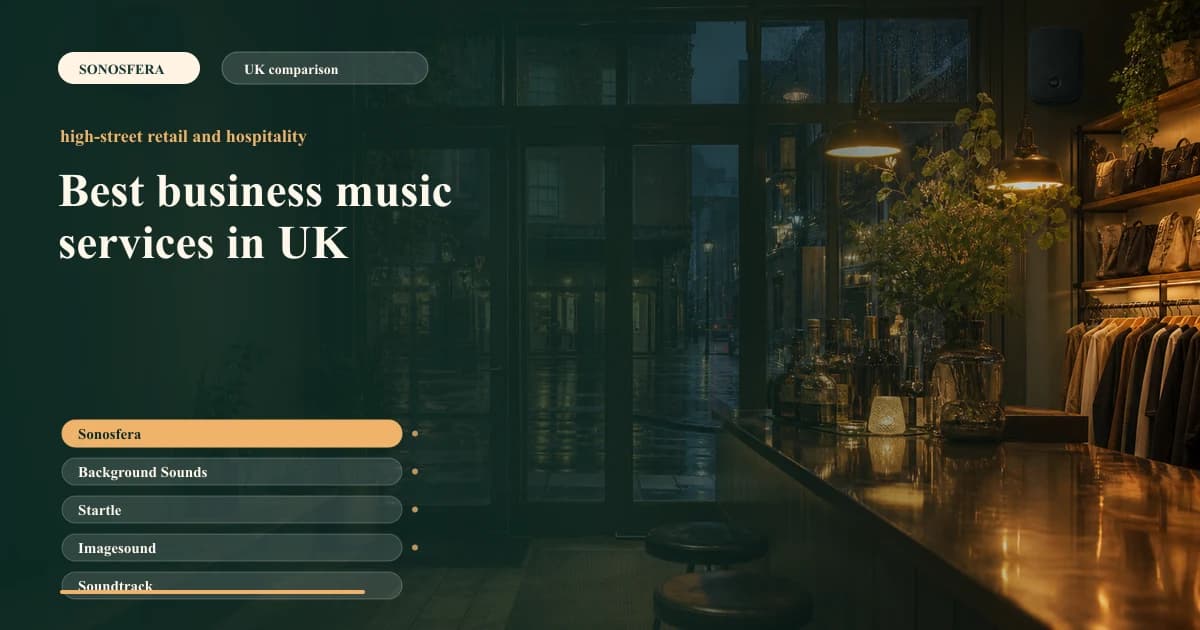
Above the self-serve tier sit managed and installed providers — quote-led names like NSM Music, Perfect Octave (a registered PPL and PRS provider), Imagesound, Mood Media and Startle — best for larger estates that want hardware and multi-site curation. One caution on the most-searched name: Soundtrack Your Brand is polished and now publishes pricing (from about $54 per zone per month billed annually), but its own UK licensing page states that public-performance rights aren't included — so you'd still need TheMusicLicence on top. See the full field on the UK comparison hub.
United States: the four PROs (and the sound-recording quirk)
In the US, the money for public performance flows to the songwriters and publishers behind a song, collected by four performing rights organizations: ASCAP, BMI, SESAC and GMR. Play a repertoire and you owe that PRO — the same baseline every service below is measured against.
Here's the quirk worth knowing. US copyright law grants no general public-performance right in the sound recording for ordinary, non-digital in-store playback. So a brick-and-mortar venue playing background music deals with the song side (the PROs) but not a separate "record label" performance fee the way the UK's PPL side works. (Digital, streaming and webcasting setups are different, and can bring SoundExchange into scope.) In practice this is why so many US business-music subscriptions can advertise "all licenses included" at a low monthly price — they're bundling the PRO obligation, not a recording royalty.
Mainstream catalogue, billed per zone with no volume discount
If your goal is fewer rights questions rather than mainstream hits, the owned-catalogue names are the ones to weigh — a service that writes its own music sits outside the ASCAP/BMI/SESAC/GMR route for that catalogue. Beyond the self-serve tier, enterprise and installed providers like Mood Media US and PlayNetwork are quote-led and aimed at multi-location brands. The US comparison hub lists the wider field, including budget streamers such as Cloud Cover Music's cheapest tiers.
United Arab Emirates: a licensing regime being built in real time
The UAE is the market where the "who collects" answer is newest. For years there was no local collecting body for public performance; that changed in 2025. Under Federal Decree-Law No. 38 of 2021 on Copyright and Neighbouring Rights, the Ministry of Economy licensed the country's first collective management organisation, the Emirates Music Rights Association (EMRA), in April 2025 — a non-profit — followed by a second, the commercial Music Nation (partnered with BMI and SoundExchange), in June 2025.
What's not settled yet is the tariff. As of early 2026, formal published venue tariff schedules were still being finalised. That makes the UAE genuinely different from the UK or US: the safest position is a service whose own catalogue is cleared and certificated, plus confirming any society licence your venue may owe as the tariffs land. Treat "worldwide" claims with care — worldwide is not the same as UAE-cleared until a provider puts it in writing — and run anything you're relying on legally past a local adviser.
Because published prices are still scarce in the Gulf, compare on rights and model rather than a headline figure. Sonosfera (/month) offers own-catalogue playback with certificate-ready records; Naistro builds plans around multi-venue GCC businesses; and enterprise curation comes from Music Concierge (MENA), Mood Media GCC and Cloud Pulse. Before you pay any of them, run this checklist — if you can't tick every box in writing, keep asking:
Cleared catalogue. The provider confirms its music is licensed for commercial public performance, not just personal listening.
UAE in scope. Coverage explicitly includes the UAE, not just "worldwide," confirmed in writing.
Certificate available. You can get a dated certificate tying the licence to your venue.
Per-zone clarity. You know whether the price is per venue or per zone, and what a second room costs.
Real checkout currency. You've seen the figure in AED, with any VAT/tax, at checkout — not just on the marketing page.
Outside-catalogue rule understood. Any music beyond the provider's own catalogue (radio, DJs, uploads, third-party playlists) is yours to clear.
Local-adviser check. For anything you're relying on legally, you've run it past a UAE adviser.
Sonosfera is a self-serve app for venues that want a consistent, on-brand sound without the overhead: playback of the Sonosfera catalogue, a visual player, category stations you can set per room, transparent per-market pricing, and certificate-ready records for paid accounts. If you'd rather try it than read another table, you can start a free trial and see the player before deciding.
The rights position is deliberately simple. Sonosfera's catalogue is fully AI-generated and rights-controlled, so playing only that catalogue does not require TheMusicLicence (PPL/PRS) in the UK, an ASCAP, BMI, SESAC or GMR licence for that music in the US, or an EMRA/Music Nation society licence for that music in the UAE — because none of those bodies represent Sonosfera's music. A Sonosfera certificate describes eligible Sonosfera catalogue playback for the covered account and period; it isn't proof for any outside source, and it doesn't claim to settle every licensing scenario in your venue.
Honestly, it's the right call when you want a good-looking, documented background-music setup built around one catalogue. It's not the tool if you specifically need commercial chart hits, enterprise hardware installed, or a managed team running dozens of sites — the names above suit those jobs better. And in the UAE especially, where venue tariffs are still being written, treat any music you add from outside Sonosfera's catalogue as yours to clear.
Frequently asked questions
Is it legal to play consumer Spotify in my business?
No — not in the UK, US or UAE. Consumer Spotify, Apple Music and YouTube are licensed for personal listening only, and their terms explicitly exclude commercial playback, whatever you pay. A venue needs a catalogue cleared for commercial use, plus the public-performance licence its country requires. Spotify sells a separate business product through partners rather than through its consumer app.
What does a business music licence actually cost?
In the UK, TheMusicLicence (PPL and PRS combined) runs from about £335 a year for a small hospitality space and £450.99 + VAT for a shop up to 100m², rising with floor area. In the US, public-performance royalties are usually bundled into a business-music subscription, from roughly $16.95 a month. In the UAE, formal venue tariffs were still being finalised in early 2026.
Do I still need PPL/PRS, the US PROs, or a UAE society licence?
If you play commercially released chart music, generally yes: PPL/PRS in the UK, and ASCAP, BMI, SESAC or GMR in the US, collect for the rights-holders behind those songs, and a UAE society licence may apply too. If you play only a provider's own cleared catalogue, that music may carry no such bill — confirm the scope in writing before you cancel anything.
Does an "own-catalogue" or royalty-free service remove the licence?
For that catalogue, yes — but only that catalogue. When a service writes or owns its music, no outside society represents it, so playing those tracks alone carries no PPL/PRS, PRO or UAE-society bill. The moment you also stream radio, chart hits, a DJ set or an uploaded playlist, the licence for that outside music is back, and it's yours to arrange.
I've got more than one room — does the price change?
Usually, yes. Most services bill per zone or per location, so a salon with a styling floor and a separate treatment room, or a café with a mezzanine, can pay twice the headline figure. Soundtrack Your Brand, for example, charges per zone with no volume discount. Always check whether a quote is per room before comparing two providers on price.