Short answer: Decide music responsibility by area and source, not by who signed the venue contract. The venue may control foyers and permanent cafés, the organiser controls exhibition and feature areas, and exhibitors bring sources onto stands. Record all three before build-up and log every show-day change.
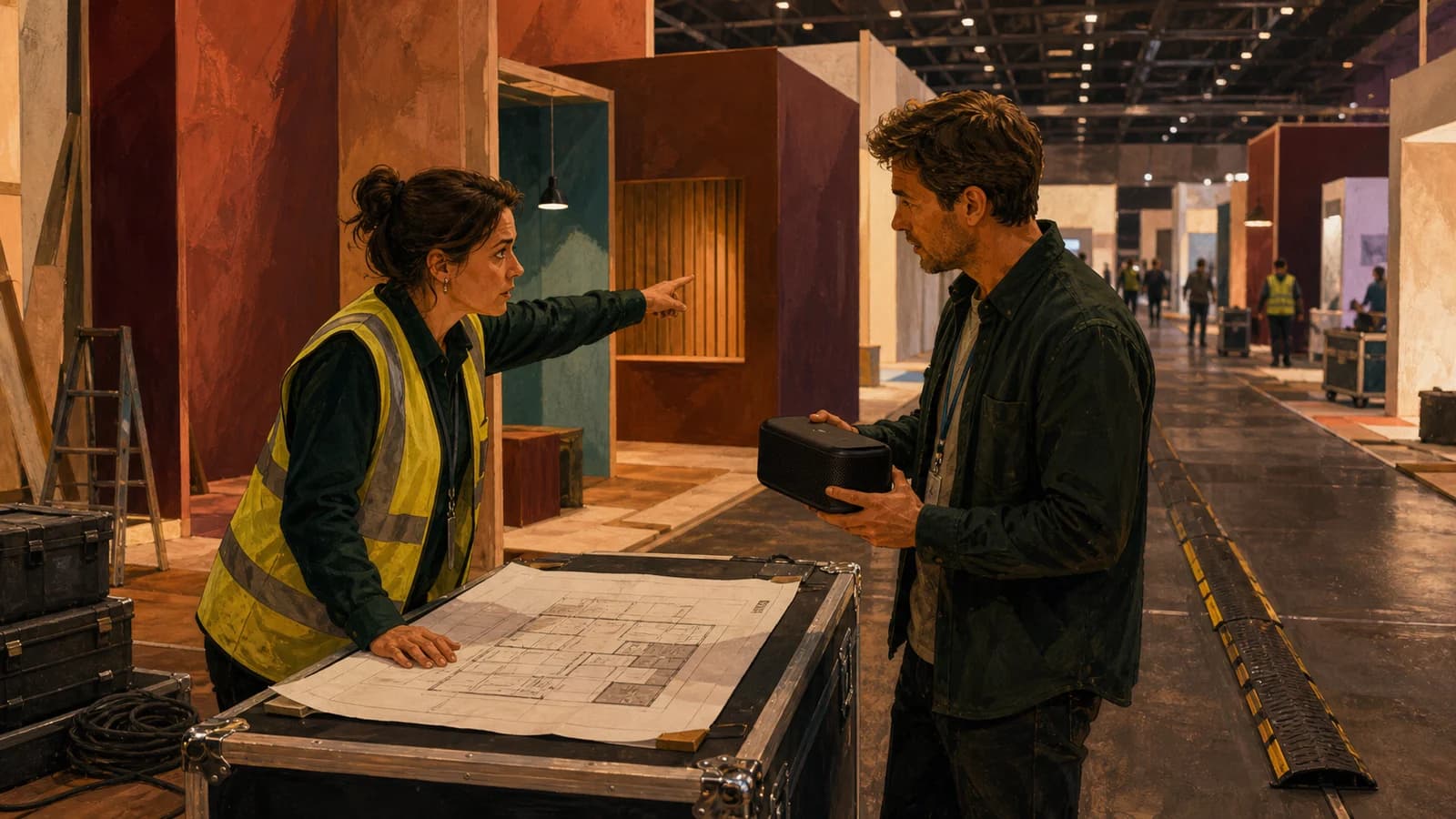
Original Sonosfera illustration; the people and exhibition are fictional and are not customers or endorsers.
Build the responsibility matrix first
| Area or use | Likely operational owner | Declare | Evidence to keep |
|---|---|---|---|
| Foyer or permanent venue café | Venue | Existing source, audible area and hours | Venue confirmation |
| Main exhibition hall | Organiser | House background source and show dates | Organiser record |
| Seminar or feature area | Organiser/producer | Walk-on, video, recorded and live uses | Running order and permissions |
| Individual stand | Exhibitor, declared to organiser | Speaker, laptop, TV, phone or live activation | Stand declaration |
| Independent franchise | Franchise/operator | Its own source and managed area | Written responsibility |
The current PPL PRS exhibition guidance separates venue, organiser/agency and exhibitor responsibilities. It also asks organisers to keep records of planned music and stand use. Read it for the current detail; the table above is a workflow, not a legal determination.
Ask every exhibitor the same six questions
Add these fields to the exhibitor portal or manual:
- Will any music be audible on the stand?
- What is the source: video, business catalogue, radio, phone, DJ or live act?
- Is the source part of a product demo or general atmosphere?
- Which dates and times will it play?
- Will it be audible beyond the stand boundary?
- Who can stop it immediately on site?
“Laptop audio” is not a sufficient answer. A product film, a looping advert and a background playlist can raise different questions.
Use a show-day change log
Exhibitors improvise. A silent screen gains a soundtrack; a brand ambassador brings a speaker; a DJ appears for an hour. Give floor managers a short log:
| Time | Stand | Previous declaration | New source/use | Approved by | Stop time |
|---|
If approval is unresolved, the source stays off. Do not let deadline pressure turn an undeclared use into an assumed permission.
Keep public-performance and event permissions separate
Confirm every declared source and use against the current exhibition guidance and venue agreement. This checklist prepares the questions; it is not legal advice or a permission by itself.
Where Sonosfera fits
For an approved background area or stand, Sonosfera can provide its own catalogue through one independent stream per zone. Current product information also lists daypart scheduling and phone control. A fixed-date route is shown on the current pricing page.
That scope does not include a stand video, uploaded advert, DJ, live act, radio or third-party playlist. Keep those as separate declarations. Use the events and pop-ups guide for the broader event plan, then check current short-term options only for the approved Sonosfera source and dates.
Close the event cleanly
- stop the organiser's temporary sources;
- confirm exhibitors have removed personal accounts and devices;
- return permanent venue areas to their normal plan;
- retain declarations and change logs with the event record;
- note any recurring stand issue before the next show.
Does the venue's licence cover every stand?
Do not assume that. The current sector guidance assigns responsibilities across venue, organiser and exhibitor roles. Ask the venue and organiser to confirm the actual arrangement in writing.
What if a stand plays only a few seconds of music?
Duration alone does not settle the issue. Declare the source and context, especially if it is embedded in a video, product demo or live activation.