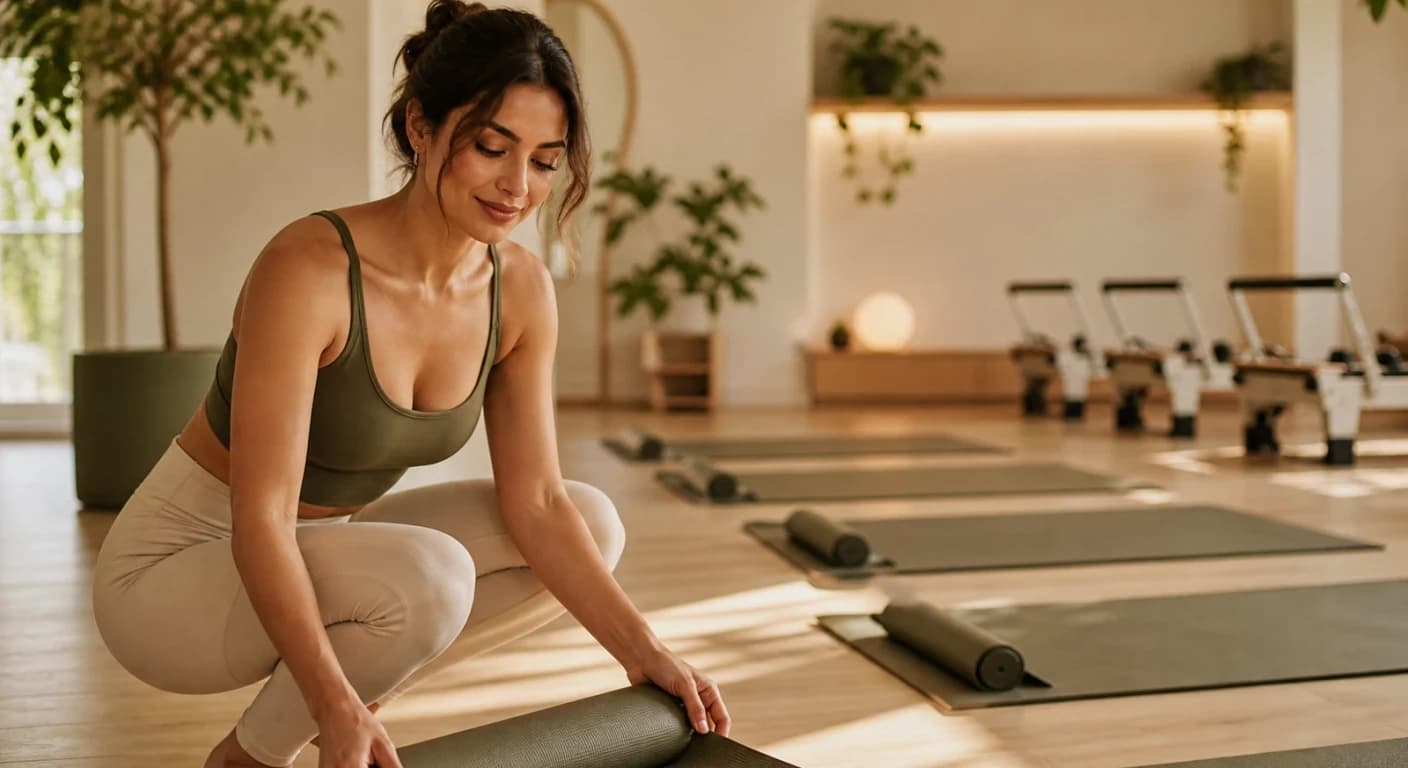
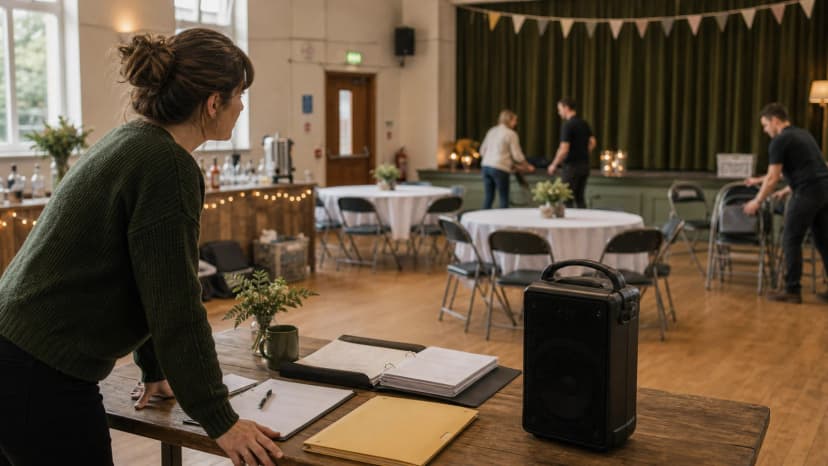
What a UK Pilates, yoga or massage studio actually needs to play music legally in class or the treatment room — how PRS and PPL work, the real 2026 costs, the catalogue routes that skip them, and which music suits each room.
Playing recorded music to clients in a Pilates, yoga or massage session is a public performance, so it normally needs cover for both the song (PRS) and the recording (PPL).
As of July 2026, TheMusicLicence for fitness classes starts at about £702 a year (£4.68 per class + VAT); background music in a studio up to 249 m² starts at £747.29 a year + VAT.
A personal Spotify, Apple Music or YouTube account is licensed for private listening only — it is never a business music source, even if you also hold TheMusicLicence.
Sonosfera-only playback does not require PPL/PRS because the catalogue is fully AI-generated and rights-controlled; it does not cover Spotify, radio, DJs, live music or third-party playlists you might also run.
The right sound differs by room — low-vocal, steady tracks for mat and flow, 50-65 BPM for massage and acupuncture — but in every case the instructor's cues should stay the loudest thing.
Sonosfera was started by a salon operator who got caught out by PPL/PRS licensing letters and built the music platform they wished existed. The team behind this blog has spent years inside hair and beauty businesses, clinics, and hospitality venues — booking the bills, dealing with the licensing letters, and learning the hard way that most Spotify playlists don't work for a professional environment.
Three very different rooms share one awkward question. A Reformer studio wants a steady pulse under the cueing. A yoga teacher scores a 75-minute flow that lands on a long, silent savasana. A massage therapist keeps the treatment room at a slow, breath-slowing hush. In all three, the moment music plays for paying clients, UK copyright law treats it as a public performance — and that usually means a licence.
This guide is for UK wellness studio owners and independent practitioners — Pilates and yoga teachers, massage therapists, acupuncturists, and the clinics that rent rooms to them — who want to play music legally without overpaying. It covers what PRS and PPL actually are, what TheMusicLicence really costs in 2026, the catalogue routes that sidestep it, and how to choose music that suits each room. It is general guidance, not legal advice; your exact position depends on your premises and how you play music.
One rule covers all three rooms
Does a UK yoga, Pilates or massage studio need a music licence?
In most cases, yes. Playing recorded music to clients in a class or treatment room is a public performance under UK copyright law, whatever your studio's size. That normally needs a licence covering two separate rights — the song and the recording — usually bought together as TheMusicLicence from PPL PRS Ltd. The main exception is playing a catalogue already cleared for commercial use.
Every commercial track carries two layers of rights, and it pays to know the difference before you choose a service:
The composition — the melody and lyrics, owned by songwriters and publishers. In the UK, PRS for Music collects for this.
The recording — the specific master a label or artist released. PPL collects for this.
When you press play in a studio you use both at once. Since 2018, PPL and PRS have sold their licences together as one product, TheMusicLicence, run by the joint venture PPL PRS Ltd. One annual payment covers both rights for most everyday business playback — including a fitness, Pilates, yoga or dance studio, and a massage or acupuncture clinic.
What it actually costs in 2026
How much does TheMusicLicence cost for a studio or clinic?
There is no flat fee — PPL PRS prices on floor area, audience and how music is used. As a real July 2026 example, an instructor running three weekly classes for 50 weeks pays from £702 a year — about £4.68 per class plus VAT. Background music in a gym or studio up to 249 m² starts at £747.29 a year plus VAT.
Those figures come from PPL PRS's own published examples for the fitness and dance sector, and they matter because the use changes the tariff:
Music as the class (exercise-to-music, where the track drives the workout) is priced per class — the £702-a-year / £1.92-a-day / £4.68-a-class example assumes three classes a week for 50 weeks.
Music as background (playing under gym floor work or in reception, not driving the session) uses an area-based tariff — from £747.29 a year, roughly £2.05 a day, for premises up to 249 m².
Both are stated "correct as of July 2026," both are subject to change, and a mixed studio can attract both elements — so confirm your own figure for your premises at pplprs.co.uk. But the headline is useful for budgeting: for a small wellness studio, TheMusicLicence realistically runs into the high hundreds of pounds a year before you have paid for the music itself.
The personal-Spotify trap — it catches all three
Can I use my personal Spotify, Apple Music or YouTube account?
No. Consumer subscriptions are licensed for private, personal listening only — Spotify's terms limit use to "personal, non-commercial" purposes, and Apple Music and YouTube say the same. Pressing play for paying clients breaks those terms, even if you separately hold TheMusicLicence. For business use you need a business-grade source, not a personal account piped through a Bluetooth speaker.
This is the single most common mistake across wellness venues, and it looks the same whether it is a yoga teacher's carefully built flow playlist or a therapist's "relaxing spa" mix: the account was never licensed for the room. Two things are true at once —
Consumer terms (Spotify, Apple Music, YouTube) restrict you to private listening. Using them in a paid class breaches the contract regardless of what is licensed underneath.
Public-performance rights are a separate question, answered by TheMusicLicence or a cleared catalogue.
Holding TheMusicLicence fixes the second problem but not the first — you still cannot legitimately deliver the music from a personal Spotify account. You need a business-grade source as well. Upgrading to the ad-free tier changes nothing here: paying to remove adverts is not the same as buying the right to play to clients.
The catalogue route: services that take PRS/PPL off the table
Can a royalty-free or AI-music service replace TheMusicLicence?
For that provider's own catalogue, yes. Sonosfera-only playback does not require PPL/PRS because the catalogue is fully AI-generated and rights-controlled — there is nothing for the societies to collect. The limit is scope: the moment you also play the radio, a Spotify playlist or any chart track in the same room, the standard public-performance question returns for those sources.
Catalogue services fall into two camps:
Royalty-free / production libraries — music not registered with PRS/PPL, so the provider argues there is nothing for the societies to collect. Background Sounds and RadioSparx work this way.
AI-generated or wholly owned catalogues — newer services that generate or own their music outright and issue a certificate for their own tracks. Sonosfera sits here.
Either can genuinely lower your bill, but only for their catalogue. Before you cancel TheMusicLicence, keep the provider's certificate on file and make sure staff play from that one source only — "royalty-free" describes the catalogue, not your whole legal position. It does not retroactively cover a chart track someone streams from their phone in the same room.
Comparing the UK options
The table sets the licence baseline against the catalogue services UK wellness businesses most often weigh up. Every figure is a publicly listed rate confirmed in July 2026; where a provider is quote-led or does not publish a rate, that is stated rather than guessed. Treat each catalogue's rights claim as the provider's own positioning to confirm in writing.
Owned, AI-generated catalogue; Sonosfera-only playback does not require PPL/PRS
Reading it honestly:
The cheapest published rates — RadioSparx from £13.50, Background Sounds at £15 — come from catalogue services that ask you to trust their catalogue-scope claim. That is fine; just verify it and keep the certificate.
Soundtrack Your Brand is the honest contrast. Even a licensed streaming service for business tells UK customers that public-performance rights sit outside its product, so TheMusicLicence may still apply. That is the safe default assumption for any chart-music setup.
Quote-led pricing from Startle or Imagesound is not a red flag — larger suppliers tailor packages to the venue, so ask for the figure in writing rather than assuming it is bundled.
Where Sonosfera fits — and where it doesn't
Sonosfera is background music built for venues like wellness studios, with a catalogue we generate and own rather than license from chart labels. Because the music is ours, Sonosfera-only playback does not require PPL/PRS, and eligible accounts can generate account proof showing exactly what the plan covers. The player leans into calm, lyric-light, mood-matched tracks that hold a focused room rather than pulling attention to a vocal — which suits a Reformer class, a yoga savasana and a treatment table alike.
The boundary is worth stating plainly: a Sonosfera certificate covers Sonosfera catalogue playback. It is not a substitute for TheMusicLicence if you also want to play recognisable chart hits, commercial radio, a guest DJ's set or third-party playlists in the same space. That is the genuine fork —
Classes built around named-artist chart tracks → licence-first: hold TheMusicLicence and pair it with a business-grade source.
A calm, original soundtrack for the room → catalogue-first: an owned catalogue is the simpler, cleaner route.
Licensing decides whether you can press play; the sound decides whether the room actually works.
What music is good for Pilates, yoga and massage?
Low-vocal, steady music that sits under the instructor's voice. Mat Pilates and yoga flow suit soft instrumental, piano or ambient textures; Reformer work and stronger sequences can take a firmer, more rhythmic pulse. For massage and acupuncture, tracks around 50-65 BPM — close to a resting heart rate — help clients slow their breathing. In every room, cues, not the soundtrack, should be the loudest thing.
The useful question is never "what genre?" but "what does this room need to feel like at this moment?" Build the playlist around the arc of the session rather than one flat energy level:
Session moment
What the music is doing
Good starting point
Arrival / reception
Help clients settle before you start
Calm, low-vocal, warm texture
Warm-up
Add gentle structure without making the room sleepy
Soft pulse, light rhythm, no big drops
Active work / Reformer
Support movement without overpowering cueing
Steadier pulse, controlled energy
Transitions
Hold concentration while position or equipment changes
Clean, predictable changes
Cool-down / savasana
Bring the room down without leaving it empty
Softer texture, less rhythmic pressure
A few room-specific notes, drawn from how studios actually programme:
Mat Pilates and yoga: quiet instrumental, piano-led or organic textures leave space for breath cues. Vocals can work when they are light and textural; strong choruses, adverts and sudden drops break the spell.
Reformer and flow: a firmer pulse helps a class move together — just keep it clean enough that you are not raising your voice over it.
Massage and acupuncture: percussion-free ambient pads and slow strings under about 60 BPM mimic a resting heart rate; for active sports-massage or physio work, a steady 70-85 BPM keeps energy moving without distraction. Rotate the set so staff are not hearing the same loop every shift.
Volume, everywhere: set it to the point where a client can hear you speak normally without you lifting your voice.
Room rental: who actually holds the licence?
Who holds the music licence when a therapist rents a room?
Responsibility falls on whoever authorises the public performance. If the clinic owner pipes music through ceiling speakers into reception and treatment rooms, the clinic's licence covers that playback. If you rent a room and bring your own speaker to play your own source, that playback is yours to account for — don't assume the landlord's paperwork stretches to cover it.
This trips up a lot of solo practitioners who rent a room two or three days a week inside a larger clinic. The test is control, not the lease: whoever decides what plays and switches it on is the one authorising the performance. A clinic-wide system fed to every room is the owner's responsibility; your own Bluetooth playlist in your own session is yours. If you use a catalogue service, its portability helps — you log in on your phone or tablet when you arrive, connect to the speaker, and keep your account and certificate tied to the room you actually use.
FAQ
Do I really need a licence for a small, one-room studio?
In most cases, yes. Playing recorded music to clients is a public performance under UK copyright law regardless of size, so it normally needs cover for both the song and the recording — usually TheMusicLicence. A few narrow legal carve-outs exist, but they rarely apply to a paid class; check your situation at pplprs.co.uk.
Can I just use Spotify Premium if I pay for it?
No. Premium removes adverts but is still a personal, private-listening licence — Apple Music and YouTube are the same. Paying for the ad-free tier does not turn a consumer account into a business music source. You need a service built for commercial spaces, or a dedicated business plan.
What music should a Reformer Pilates class use?
Reformer classes can take a little more rhythm than quiet mat or yoga sessions, especially through stronger sequences. Keep it clean and controlled so clients move together without the instructor shouting over the track. A steady, moderate pulse usually beats chart pop with big choruses and abrupt drops.
Do I need a licence if I only play classical music?
Usually, yes. The composition may be public domain if the composer died long ago, but the specific recording is still copyrighted — the performers and label own it. Unless you are playing recordings explicitly released as public-domain or cleared for commercial use, the recording right still applies.
Is "royalty-free" music from YouTube actually safe for a clinic?
Not automatically. "Royalty-free" means no per-play royalty, not "free of public-performance licensing." If the track's creator belongs to a rights society, playing it in your clinic can still need TheMusicLicence — and free YouTube playlists also risk adverts and erratic volume mid-session. A cleared business catalogue avoids both problems.
What is the difference between PPL and PRS?
They collect for two different groups. PRS for Music pays the people who wrote the song (the composition). PPL pays the people who recorded it (the performers and label). Most UK businesses cover both at once through the single combined TheMusicLicence.
Strip it back and the decision is small. Write down where music plays — reception, class, treatment room, recorded content — what source feeds each space, and who switches it on. If any of that is a personal Spotify account in a paid room, fix that first. Then choose your route: if your sessions live on named-artist chart tracks, budget for TheMusicLicence plus a business-grade player; if a calm, original soundtrack does the job, an owned catalogue like Sonosfera covers the room without the PRS/PPL question — provided it is the only source playing. Either way, keep the certificate or licence somewhere you can find it, because "I'll turn it off if someone asks" is not a compliance plan.