Music for a charity event in the UK: what to check before pressing play
Planning music for a UK charity event? Use this checklist to sort out who controls the music source, which permissions apply, and where Sonosfera fits.
By Sonosfera Team·Background music for UK businesses··Updated
Key Takeaways
A speaker is just hardware. The real question is the music source — a venue subscription, a DJ, a radio feed, a personal playlist or a catalogue service all carry different permissions.
Charity, free entry or community status does not automatically exempt your event from music permissions. Confirm the rules in writing before doors open.
In the UK, public-performance permission for most recorded music runs through TheMusicLicence (PPL and PRS for Music). Background music and DJ/live sets can raise separate questions.
A Temporary Event Notice from your council covers things like alcohol and regulated entertainment — it is not a music licence. Don't confuse the two.
Sonosfera only covers eligible playback of its own catalogue. It does not replace your local event, venue or collecting-society checks.
Use Sonosfera for eligible catalogue background playback in United Kingdom, then keep DJs, live music, radio, uploaded tracks, venue terms, and local permissions in their own checks.
Music for a charity event in the UK: what to check before pressing play
By Sonosfera Team
Direct answer: A UK charity event should check music permission before playback when recorded music, a DJ, a live act, radio, volunteer speakers or sponsor videos can be heard by guests, donors, volunteers or the public. Charity status, free entry or community purpose does not automatically remove public-performance checks. Confirm who controls each music source, whether PPL PRS/TheMusicLicence covers the exact event date, rooms, audience and repertoire, and whether a separate Temporary Event Notice is needed for alcohol, late-night refreshment or regulated entertainment. Sonosfera can cover eligible background playback from the Sonosfera catalogue, but it does not cover Spotify, YouTube, radio, DJs, live music, mainstream repertoire, uploaded files or third-party playlists.
Charity-event music moment
What to check
Arrival, raffle or dining-room background
Confirm TheMusicLicence scope for the source, public areas, date and organiser/venue responsibility.
Volunteer or stallholder speakers
Set source/device rules before load-in so personal playlists do not become the event plan.
DJ, live act, stage or reveal cue
Treat it as featured entertainment and check it separately from background atmosphere.
Alcohol, late-night food or regulated entertainment
Check the council Temporary Event Notice route separately from music copyright.
Sonosfera background areas
Use only the Sonosfera catalogue for eligible playback, with official PPL PRS and venue checks beside it.
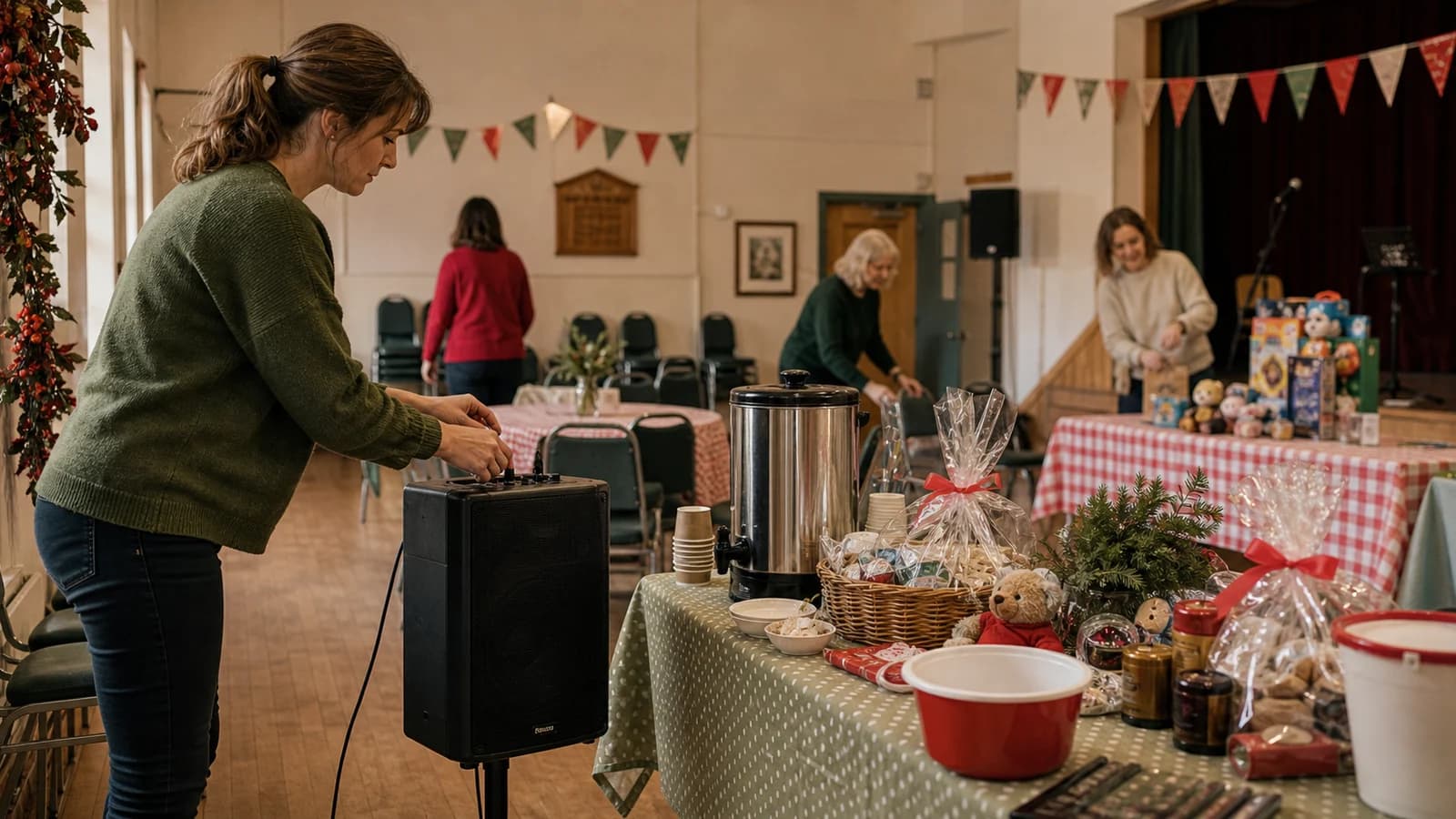
You have booked the hall, lined up the raffle, and someone has promised to bring a speaker. Music feels like the easy part — until the day itself, when a volunteer plugs a phone into the PA and starts a Spotify playlist while the room fills up. That moment is where most charity events quietly lose control of their music: nobody decided in advance who was responsible for it, where it came from, or whether it was actually allowed.
This guide is for the person organising a charity, fundraiser or community event in the UK — the volunteer, committee member or event lead who has to make sure the music side is sorted. It walks through the questions worth answering before you press play, in plain language. It is informational, not legal advice, so confirm your own setup with your venue, your suppliers and the relevant licensing body before the doors open.
Start with the music source, not the speaker
Most teams start with the speaker: the PA in the corner, the venue's ceiling system, a stallholder's Bluetooth box, a laptop at the registration desk. That is the wrong first step.
A speaker is only hardware. What matters is the source feeding it. That source might be the venue's own music subscription, a DJ's library, a radio broadcast, a personal streaming account, a live act, a sponsor's video, a mainstream playlist, or a catalogue service such as Sonosfera. Those routes do not carry the same permissions. The venue may have an arrangement for its own day-to-day background music, but that does not automatically stretch to cover a third party's fundraiser, a market with traders, or a DJ playing chart hits.
So write the sources down before setup. If a supplier or venue says "we've got it covered," ask what "it" actually means. Does it cover your event date? Your rooms or outdoor areas? Your event type and any commercial or ticketed element? The specific music being played, and the person controlling playback? If the answer is vague, treat it as unresolved until the venue or licensing body confirms it.
A practical checklist before doors open
This is deliberately operational — a way to stop the last-minute improvisation that ends with an unapproved playlist on someone's phone.
Don't assume that charity, school, free-entry or community status creates an exemption from music permissions.
Confirm whether the venue or the organiser is responsible for music licensing for this specific event.
Record the arrangements for live acts, DJs, the raffle or dining room, and arrival music separately — they aren't all the same.
Name one person who owns music decisions before setup starts.
List every music source: house system, stallholder speaker, DJ, live act, radio, personal playlist, uploaded file, and any catalogue service.
Separate background atmosphere from featured moments — performances, reveal cues, walk-ons, or anything being filmed.
Keep venue emails, licence receipts, service records and speaker-zone notes together in one folder.
If music is left until doors open, someone usually fills the silence with whatever is already plugged in. Naming an owner and an approved source in advance is the single cheapest way to keep both compliance and the atmosphere under control.
How UK music permissions actually work
A quick definition first. In the UK, playing recorded music in public — at an event, in a shop, in a venue — usually needs permission from the people who own the rights to that music. TheMusicLicence is the combined licence that covers this for most businesses and events. It is administered jointly by PPL (which represents record companies and performers) and PRS for Music (which represents songwriters, composers and publishers). One licence, two sets of rights.
The practical question is scope. Check whether the official route applies to your event type, your venue, your audience, your duration and your music source. Fees, categories and event definitions change over time, so rather than rely on a figure copied from an old forum post, check the current rate and rules directly with the source — PPL PRS for Music's help pages and its live events and festivals guidance.
A few things worth flagging:
If the event is free, charitable, small, seasonal or held inside a venue that normally plays music, you should still check the official route. Those details may affect the form or the fee, but don't treat them as automatic exemptions without written confirmation.
A DJ set, live act, stage show, radio feed, uploaded file or mainstream catalogue can raise its own separate questions. Don't let one background-music plan silently expand to cover all of them.
Don't confuse a Temporary Event Notice with a music licence
If you are serving alcohol or putting on regulated entertainment at a one-off event, you may need a Temporary Event Notice (TEN) from your local council. A TEN is a council permission — it is not a music licence and it does not replace TheMusicLicence. You can read what a TEN actually covers on GOV.UK's Temporary Events Notice page. Plenty of organisers assume the TEN "handles the music." It doesn't. Treat the two as separate checks.
Where Sonosfera fits — and where it doesn't
Sonosfera is useful when you want one controlled, eligible source of background music for the parts of the event that just need atmosphere — the arrival area, the queue, the browsing space — instead of a different playlist from every volunteer and vendor. It plays the Sonosfera catalogue in supported commercial settings, which keeps the source consistent and easy to point to in your records.
It is worth being clear about the limit. Sonosfera does not cover Spotify, YouTube, radio, DJs, live music, mainstream repertoire outside its own catalogue, uploaded files, sponsor videos or third-party playlists. It also does not replace local event permits, venue permission, alcohol permissions, noise rules, or collecting-society checks where those apply. Use Sonosfera for the Sonosfera source; use the official routes above for everything else.
Do charity and community events still need music permissions?
Usually, yes. Running an event for charity, for free, or for the community does not in itself create an exemption from public-performance permissions. The safest approach is to name an owner in writing: if you control the programme, you keep the source records; if the venue controls the music, get written confirmation of exactly what is covered for your event. Check the current rules directly with PPL PRS for Music rather than relying on assumptions.
Does the venue's licence cover my whole event?
Sometimes a venue holds TheMusicLicence for its own day-to-day music use — but don't assume that automatically covers a third-party event, stallholder speakers, a DJ, a live act, a brand activation or a filmed reveal. Ask the venue specifically what is covered for this event, on this date, in these rooms or outdoor zones, and keep the reply.
Can vendors or staff just use their personal streaming accounts?
It's best not to rely on personal Spotify, Apple Music or YouTube accounts for public event playback — most of those consumer services are licensed for personal use, not for playing to a crowd, and you also lose control of the source and the record trail. Put the permitted source and device rules in your trader or volunteer brief so everyone knows what's allowed before load-in.
Does Sonosfera replace official UK licensing checks?
No. Sonosfera is a catalogue-specific playback route for eligible use of the Sonosfera catalogue in supported commercial settings. It sits beside the official event, venue and collecting-society checks that apply to your event — it doesn't remove them.